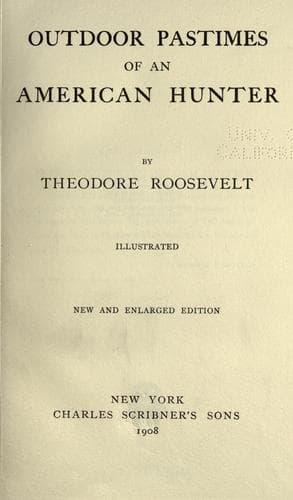
Outdoor pastimes of an American hunterRoosevelt, Theodore
General
Outdoor pastimes of an American hunter
Roosevelt, Theodore
Hunting -- United States; Hunting -- West (U.S.)
he can only be sure of possessing this capacity by occasionally
exercising it. It ought to be unnecessary to point out that the
wilderness is not a place for those who are dependent upon luxuries, and
above all for those who make a camping trip an excuse for debauchery.
Neither the man who wants to take a French cook and champagne on a
hunting trip, nor his equally objectionable though less wealthy brother
who is chiefly concerned with filling and emptying a large whiskey jug,
has any place whatever in the real life of the wilderness.
The chase of an animal should rank according as it calls for the
exercise in a high degree of a large number of these qualities. The
grizzly is almost our only dangerous game, and under certain conditions
shooting the grizzly calls for considerable courage on the part of the
hunter. Disregarding these comparatively rare occasions, the chase of
mountain game, especially the bighorn, demands more hardihood, power of
endurance, and moral and physical soundness than any other kind of
sport, and so must come first. The wapiti and mule-deer rank next, for
they too must be killed by stalking as a result of long tramps over very
rough ground. To kill a moose by still hunting is a feat requiring a
high degree of skill, and entailing severe fatigue. When game is
followed on horseback, it means that the successful hunter must ride
well and boldly.
The whitetail is occasionally found where it yields a very high quality
of sport. But normally it lives in regions where it is extremely
difficult to kill it legitimately, as the wapiti and mule-deer are
killed, and yet comparatively easy to kill it under circumstances which
make no demand for any particular prowess on the part of the hunter. It
is far more difficult to still hunt successfully in the dense brushy
timber frequented by the whitetail than in the open glades, the
mountains, and the rocky hills, through which the wapiti and mule-deer
wander. The difficulty arises, however, because the chief requirement is
stealth, noiselessness. The man who goes out into the hills for a
mule-deer must walk hard and far, must be able to bear fatigue, and
possibly thirst and hunger, must have keen eyes, and be a good shot. He
does not need to display the extraordinary power of stealthy advance
which is necessary to the man who would creep up to and kill a whitetail
in thick timber. Now, the qualities of hardihood and endurance are
better than the quality of stealth, and though all three are necessary
in both kinds of chase, yet it is the chase of the mule-deer which most
develops the former, and the chase of the whitetail which most develops
the latter. When the woods are bare and there is some snow on the
ground, however, still hunting the whitetail becomes not only possible,
but a singularly manly and attractive kind of sport. Where the whitetail
can be followed with horse and hound, the sport is also of a very high
order. To be able to ride through woods and over rough country at full
Public-domain text, read in full here on John Shaqi.
Reviews
Reviews
No reviews yet
Be the first to share your thoughts on this work.
Elsewhere in the archive
Join the Discussion
Join the discussion
Sign in to leave a comment or review.
Sign InorCreate an account