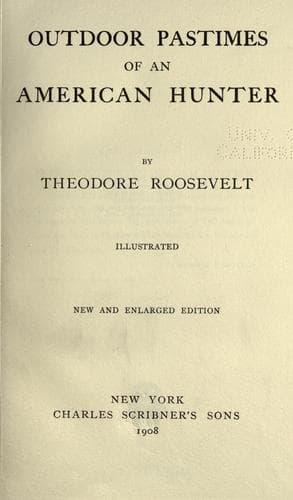
Outdoor pastimes of an American hunterRoosevelt, Theodore
General
Outdoor pastimes of an American hunter
Roosevelt, Theodore
Hunting -- United States; Hunting -- West (U.S.)
This is the largest and finest of our three smaller deer. Throughout its
range it is known as the blacktail deer, and it has as good a historic
claim to the title as its Pacific coast kinsman, the coast or true
blacktail. In writing purely of this species, it seems like pedantry to
call it by its book name of mule-deer, a name which conveys little or no
meaning to the people who live in its haunts and who hunt it; but it is
certainly very confusing to know two distinct types of deer by one name,
and as both the Rocky Mountain blacktail and Coast blacktail are thus
known, and as the former is occasionally known as mule-deer, I shall,
for convenience’ sake, speak of it under this name—a name given it
because of its great ears, which rather detract from its otherwise very
handsome appearance.
The mule-deer is a striking and beautiful animal. As is the case with
our other species, it varies greatly in size, but is on the average
heavier than either the whitetail or the true blacktail. The horns also
average longer and heavier, and in exceptional heads are really
noteworthy trophies. Ordinarily a full-grown buck has a head of ten
distinct and well-developed points, eight of which consist of the
bifurcations of the two main prongs into which each antler divides,
while in addition there are two shorter basal or frontal points. But the
latter are very irregular, being sometimes missing; while sometimes
there are two or three of them on each antler. When missing it usually
means that the antlers are of young animals that have not attained their
full growth. A yearling will sometimes have merely a pair of spikes, and
sometimes each spike will be bifurcated so as to make two points. A
two-year-old may develop antlers which, though small, possess the normal
four points. Occasionally, where unusually big heads are developed,
there are a number of extra points. If these are due to deformity, they
simply take away from the beauty of the head; but where they are
symmetrical, while at the same time the antlers are massive, they add
greatly to the beauty. All the handsomest and largest heads show this
symmetrical development of extra points. It is rather hard to lay down a
hard-and-fast rule for counting them. The largest and finest antlers are
usually rough, and it is not easy to say when a particular point in
roughness has developed so that it may legitimately be called a prong.
The largest head I ever got to my own rifle had twenty-eight points,
symmetrically arranged, the antlers being rough and very massive as well
as very long. The buck was an immense fellow, but no bigger than other
bucks I have shot which possessed ordinary heads.
Public-domain text, read in full here on John Shaqi.
Reviews
Reviews
No reviews yet
Be the first to share your thoughts on this work.
Elsewhere in the archive
Join the Discussion
Join the discussion
Sign in to leave a comment or review.
Sign InorCreate an account