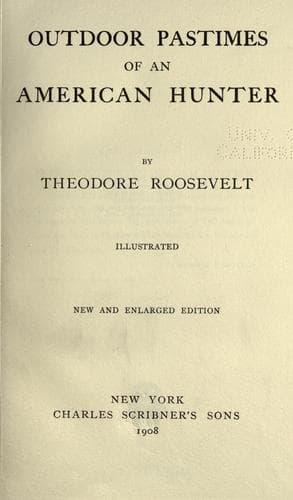
Outdoor pastimes of an American hunterRoosevelt, Theodore
General
Outdoor pastimes of an American hunter
Roosevelt, Theodore
Hunting -- United States; Hunting -- West (U.S.)
It must be remembered, however, that with the mule-deer, as with all
other species of animals, there is a wide variability in habits under
different conditions. This is often forgotten even by trained
naturalists, who accept the observations made in one locality as if they
applied throughout the range of the species. Thus in the generally good
account of the habits of this species in Mr. Lydeker’s book on the “Deer
of All Lands” it is asserted that mule-deer never dwell permanently in
the forest, and feed almost exclusively on grass. The first statement is
entirely, the second only partly, true of the mule-deer of the plains
from the Little Missouri westward to the headwaters of the Platte, the
Yellowstone, and the Big Horn; but there are large parts of the Rockies
in which neither statement applies at all. In the course of several
hunting trips among the densely wooded mountains of western Montana,
along the water-shed separating the streams that flow into Clarke’s Fork
of the Columbia from those that ultimately empty into Kootenay Lake, I
found the mule-deer plentiful in many places where practically the whole
country was covered by dense forest, and where the opportunities for
grazing were small indeed, as we found to our cost in connection with
our pack-train. In this region the mule-deer lived the entire time among
the timber, and subsisted for the most part on browse. Occasionally they
would find an open glade and graze; but the stomachs of those killed
contained not grass, but blueberries and the leaves and delicate tips of
bushes. I was not in this country in winter, but it was evident that
even at that season the deer must spend their time in the thick timber.
There was no chance for them to go above the timber line, because the
mountains were densely wooded to their summits, and the white goats of
the locality also lived permanently in the timber.[3] It was far harder
to get the mule-deer than it was to get the white goats, for the latter
were infinitely more conspicuous, were slower in their movements, and
bolder and less shy. Almost the only way we succeeded in killing the
deer was by finding one of their well-trodden paths and lying in wait
beside it very early in the morning or quite late in the afternoon. The
season was August and September, and the deer were astir long before
sunset. They usually, but not always, lay high up on the mountain-sides,
and while they sometimes wandered to and fro browsing on the mountains,
they often came down to feed in the valleys, where the berries were
thicker. Their paths were well beaten, although, like all game trails,
after being as plainly marked as a pony track for a quarter of a mile or
so, they would suddenly grow faint and vanish. The paths ran nearly
straight up and down hill, and even when entirely undisturbed, the deer
often came down them at a great rate, bouncing along in a way that
showed that they had no fear of developing the sprung knees which we
Public-domain text, read in full here on John Shaqi.
Reviews
Reviews
No reviews yet
Be the first to share your thoughts on this work.
Elsewhere in the archive
Join the Discussion
Join the discussion
Sign in to leave a comment or review.
Sign InorCreate an account