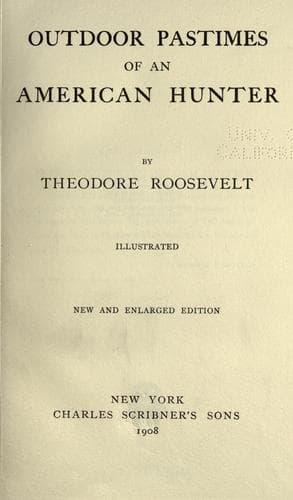
Outdoor pastimes of an American hunterRoosevelt, Theodore
General
Outdoor pastimes of an American hunter
Roosevelt, Theodore
Hunting -- United States; Hunting -- West (U.S.)
The deer were preyed on by many foes. Sportsmen and hide-hunters had
been busy during the fall migrations, and the ranchmen of the
neighborhood were shooting them occasionally for food, even when we were
out there. The cougars at this season were preying upon them practically
to the exclusion of everything else. We came upon one large fawn which
had been killed by a bobcat. The gray wolves were also preying upon
them. A party of these wolves can sometimes run down even an unwounded
blacktail; I have myself known of their performing this feat. Twice on
this very hunt we came across the carcasses of blacktail which had thus
been killed by wolves, and one of the cow-punchers at a ranch where we
were staying came in and reported to us that while riding among the
cattle that afternoon he had seen two coyotes run a young mule-deer to a
standstill, and they would without doubt have killed it had they not
been frightened by his approach. Still the wolf is very much less
successful than the cougar in killing these deer, and even the cougar
continually fails in his stalks. But the deer were so plentiful that at
this time all the cougars we killed were very fat, and evidently had no
difficulty in getting as much venison as they needed. The wolves were
not as well off, and now and then made forays on the young stock of the
ranchmen, which at this season the cougar let alone, reserving his
attention to them for the summer season when the deer had vanished.
In the Big Horn Mountains, where I also saw a good deal of the
mule-deer, their habits were intermediate between those of the species
that dwell on the plains and those that dwell in the densely timbered
regions of the Rockies farther to the northwest. In the summer time they
lived high up on the plateaus of the Big Horn, sometimes feeding in the
open glades and sometimes in the pine forests. In the fall they browsed
on certain of the bushes almost exclusively. In winter they came down
into the low country. South of the Yellowstone Park, where the wapiti
swarmed, the mule-deer were not numerous. I believe that by choice they
prefer rugged, open country, and they certainly care comparatively
little for bad weather, as they will often visit bleak, wind-swept
ridges in midwinter, as being places where they can best get food at
that season, when the snow lies deep in the sheltered places.
Nevertheless, many of the species pass their whole life in thick timber.
[Illustration:
THE RANCH-HOUSE
]
Public-domain text, read in full here on John Shaqi.
Reviews
Reviews
No reviews yet
Be the first to share your thoughts on this work.
Elsewhere in the archive
Join the Discussion
Join the discussion
Sign in to leave a comment or review.
Sign InorCreate an account