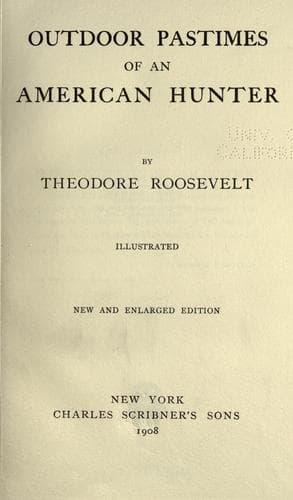
Outdoor pastimes of an American hunterRoosevelt, Theodore
General
Outdoor pastimes of an American hunter
Roosevelt, Theodore
Hunting -- United States; Hunting -- West (U.S.)
These hunts were always made late in the fall, usually after the close
of the rut. The deer were then banded, and were commonly found in
parties of from three or four to a score, although the big bucks might
be lying by themselves. The weather was apt to be cold, and the deer
evidently liked to sun themselves, so that at midday they could be found
lying sometimes in thin brush and sometimes boldly out on the face of a
cliff or hill. If they were unmolested, they would feed at intervals
throughout the day, and not until the bands had been decimated by
excessive hunting did they ever spend the hours of daylight in hiding.
On such a hunt our proceedings were simple. The nights were longer than
the days, and therefore we were away from camp at the first streak of
dawn, and might not return until long after darkness. All the time
between was spent in climbing and walking through the rugged hills,
keeping a sharp lookout for our game. Only too often we were seen before
we ourselves saw the quarry, and even when this was not the case the
stalks were sometimes failures. Still blank days were not very common.
Probably every hunter remembers with pride some particular stalk. I
recall now outwitting a big buck which I had seen and failed to get on
two successive days. He was hanging about a knot of hills with brush on
their shoulders, and was not only very watchful, but when he lay down
always made his bed at the lower end of a brush patch, whence he could
see into the valley below, while it was impossible to approach him from
above, through the brush, without giving the alarm. On the third day I
saw him early in the morning, while he was feeding. He was very
watchful, and I made no attempt to get near him, simply peeping at him
until he finally went into a patch of thin brush and lay down. As I knew
what he was I could distinctly make him out. If I had not seen him go
in, I certainly never would have imagined that he was a deer, even had
my eyes been able to pick him out at all among the gray shadows and
small dead tree-tops. Having waited until he was well settled down, I
made a very long turn and came up behind him, only to find that the
direction of the wind and the slope of the hill rendered it an absolute
impossibility to approach him unperceived. After careful study of the
ground I abandoned the effort, and returned to my former position,
having spent several hours of considerable labor in vain. It was now
about noon, and I thought I would lie still to see what he would do when
he got up, and accordingly I ate my lunch stretched at full length in
the long grass which sheltered me from the wind. From time to time I
peered cautiously between two stones toward where the buck lay. It was
nearly mid-afternoon before he moved. Sometimes mule-deer rise with a
single motion, all four legs unbending like springs, so that the four
hoofs touch the ground at once. This old buck, however, got up very
Public-domain text, read in full here on John Shaqi.
Reviews
Reviews
No reviews yet
Be the first to share your thoughts on this work.
Elsewhere in the archive
Join the Discussion
Join the discussion
Sign in to leave a comment or review.
Sign InorCreate an account