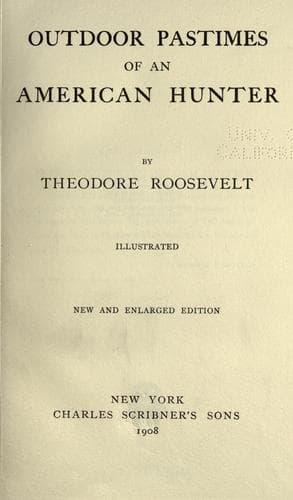
Outdoor pastimes of an American hunterRoosevelt, Theodore
General
Outdoor pastimes of an American hunter
Roosevelt, Theodore
Hunting -- United States; Hunting -- West (U.S.)
The wapiti is the largest and stateliest deer in the world. A full-grown
bull is as big as a steer. The antlers are the most magnificent trophies
yielded by any game animal of America, save the giant Alaskan moose.
When full-grown they are normally of twelve tines; frequently the tines
are more numerous, but the increase in their number has no necessary
accompaniment in increase in the size of the antlers. The length,
massiveness, roughness, spread, and symmetry of the antlers must all be
taken into account in rating the value of a head. Antlers over fifty
inches in length are large; if over sixty, they are gigantic. Good heads
are getting steadily rarer under the persecution which has thinned out
the herds.
Next to the bison the wapiti is of all the big game animals of North
America the one whose range has most decreased. Originally it was found
from the Pacific coast east across the Alleghanies, through New York to
the Adirondacks, through Pennsylvania into western New Jersey, and far
down into the mid-country of Virginia and the Carolinas. It extended
northward into Canada, from the Great Lakes to Vancouver; and southward
into Mexico, along the Rockies. Its range thus corresponded roughly with
that of the bison, except that it went farther west and not so far
north. In the early colonial days so little heed was paid by writers to
the teeming myriads of game that it is difficult to trace the wapiti’s
distribution in the Atlantic coast region. It was certainly killed out
of the Adirondacks long before the period when the backwoodsmen were
settling the valleys of the Alleghany Mountains; there they found the
elk abundant, and the stately creatures roamed in great bands over
Tennessee, Kentucky, Ohio, and Indiana when the first settlers made
their way into what are now these States, at the outbreak of the
Revolution. These first settlers were all hunters, and they followed the
wapiti (or, as they always called it, the elk) with peculiar eagerness.
In consequence its numbers were soon greatly thinned, and about the
beginning of the present century it disappeared from that portion of its
former range lying south of the Great Lakes and between the Alleghanies
and the Mississippi. In the northern Alleghanies it held its own much
longer, the last individual of which I have been able to get record
having been killed in Pennsylvania in 1869. In the forests of northern
Wisconsin, northern Michigan, and Minnesota wapiti existed still longer,
and a very few individuals may still be found. A few are left in
Manitoba. When Lewis and Clark and Pike became the pioneers among the
explorers, army officers, hunters, and trappers who won for our people
the great West, they found countless herds of wapiti throughout the high
plains country from the Mississippi River to the Rocky Mountains.
Throughout this region it was exterminated almost as rapidly as the
bison, and by the early eighties there only remained a few scattered
Public-domain text, read in full here on John Shaqi.
Reviews
Reviews
No reviews yet
Be the first to share your thoughts on this work.
Elsewhere in the archive
Join the Discussion
Join the discussion
Sign in to leave a comment or review.
Sign InorCreate an account