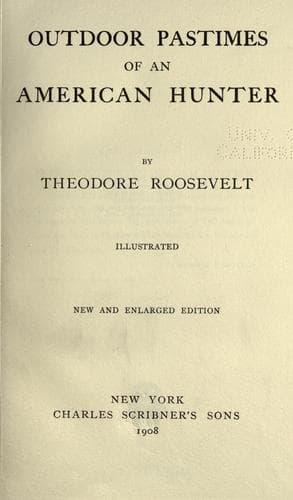
Outdoor pastimes of an American hunterRoosevelt, Theodore
General
Outdoor pastimes of an American hunter
Roosevelt, Theodore
Hunting -- United States; Hunting -- West (U.S.)
As the horns begin to harden the bulls thrash the velvet off against
quaking asp, or ash, or even young spruce, splintering and battering the
bushes and small trees. The cows and calves begin to assemble; the bulls
seek them. But the bulls do not run the cows as among the smaller deer
the bucks run the does. The time of the beginning of the rut varies in
different places, but it usually takes place in September, about a month
earlier than that of the deer in the same locality. The necks of the
bulls swell and they challenge incessantly, for, unlike the smaller
deer, they are very noisy. Their love and war calls, when heard at a
little distance amid the mountains, have a most musical sound.
Frontiersmen usually speak of their call as “whistling,” which is not an
appropriate term. The call may be given in a treble or in a bass, but
usually consists of two or three bars, first rising and then falling,
followed by a succession of grunts. The grunts can only be heard when
close up. There can be no grander or more attractive chorus than the
challenging of a number of wapiti bulls when two great herds happen to
approach one another under the moonlight or in the early dawn. The
pealing notes echo through the dark valleys as if from silver bugles,
and the air is filled with the wild music. Where little molested the
wapiti challenge all day long.
They can be easiest hunted during the rut, the hunter placing them, and
working up to them, by the sound alone. The bulls are excessively
truculent and pugnacious. Each big one gathers a herd of cows about him
and drives all possible rivals away from his immediate neighborhood,
although sometimes spike bulls are allowed to remain with the herd.
Where wapiti are very abundant, however, many of these herds may join
together and become partially welded into a mass that may contain
thousands of animals. In the old days such huge herds were far from
uncommon, especially during the migrations; but nowadays there only
remain one or two localities in which wapiti are sufficiently plentiful
ever to come together in bands of any size. The bulls are incessantly
challenging and fighting one another, and driving around the cows and
calves. Each keeps the most jealous watch over his own harem, treating
its members with great brutality, and is selfishly indifferent to their
fate the instant he thinks his own life in jeopardy. During the rut the
erotic manifestations of the bull are extraordinary.
[Illustration:
THE PACK-TRAIN
]
Public-domain text, read in full here on John Shaqi.
Reviews
Reviews
No reviews yet
Be the first to share your thoughts on this work.
Elsewhere in the archive
Join the Discussion
Join the discussion
Sign in to leave a comment or review.
Sign InorCreate an account