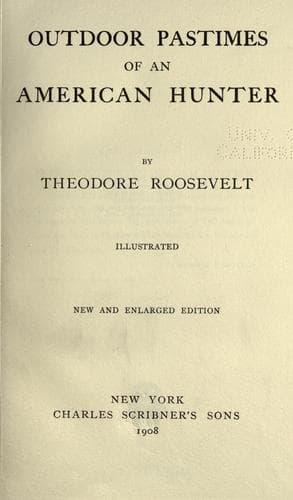
Outdoor pastimes of an American hunterRoosevelt, Theodore
General
Outdoor pastimes of an American hunter
Roosevelt, Theodore
Hunting -- United States; Hunting -- West (U.S.)
The bulls fight desperately with one another. The two combatants come
together with a resounding clash of antlers, and then push and strain
with their mouths open. The skin on their necks and shoulders is so
thick and tough that the great prongs cannot get through or do more than
inflict bruises. The only danger comes when the beaten party turns to
flee. The victor pursues at full speed. Usually the beaten one gets off;
but if by accident he is caught where he cannot escape, he is very apt
to be gored in the flank and killed. Mr. Baillie-Grohman has given a
very interesting description of one such fatal duel of which he was an
eye-witness on a moonlight night in the mountains. I have never known of
the bull trying to protect the cow from any enemy. He battles for her
against rivals with intense ferocity; but his attitude toward her, once
she is gained, is either that of brutality or of indifference. She will
fight for her calf against any enemy which she thinks she has a chance
of conquering, although of course not against man. But the bull leaves
his family to their fate the minute he thinks there is any real danger.
During the rut he is greatly excited, and does not fear a dog or a
single wolf, and may join with the rest of the herd of both sexes in
trying to chase off one or the other, should he become aware of its
approach. But if there is serious danger, his only thought is for
himself, and he has no compunctions about sacrificing any of his family.
When on the move a cow almost always goes first, while the bull brings
up the rear.
In domestication the bulls are very dangerous to human beings, and will
kill a man at once if they can get him at a disadvantage; but in a state
of nature they rarely indeed overcome their abject terror of humanity,
even when wounded and cornered. Of course, if the man comes straight up
to him where he cannot get away, a wapiti will fight as, under like
circumstances, a blacktail or whitetail will fight, and equally, of
course, he is then far more dangerous than his smaller kinsfolk; but he
is not nearly so apt to charge as a bull moose. I have never known but
two authentic instances of their thus charging. One happened to a hunter
named Bennett, on the Little Missouri; the other to a gentleman I met, a
doctor, in Meeker, Colorado. The doctor had wounded his wapiti, and as
it was in the late fall, followed him easily in the snow. Finally he
came upon the wapiti standing where the snow was very deep at the bottom
of a small valley, and on his approach the wapiti deliberately started
to break his way through the snow toward him, and had almost reached him
when he was killed. But for every one such instance of a wapiti’s
charging there are a hundred in which a bull moose has charged. Senator
Redfield Proctor was charged most resolutely by a mortally hurt bull
moose which fell in the death throes just before reaching him; and I
could cite case after case of the kind.
Public-domain text, read in full here on John Shaqi.
Reviews
Reviews
No reviews yet
Be the first to share your thoughts on this work.
Elsewhere in the archive
Join the Discussion
Join the discussion
Sign in to leave a comment or review.
Sign InorCreate an account