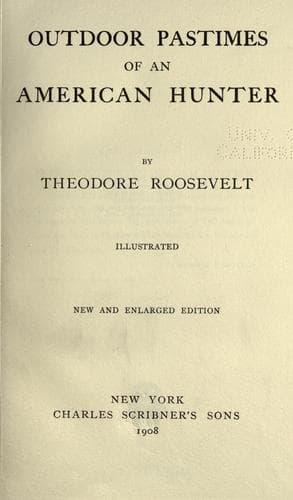
Outdoor pastimes of an American hunterRoosevelt, Theodore
General
Outdoor pastimes of an American hunter
Roosevelt, Theodore
Hunting -- United States; Hunting -- West (U.S.)
An hour afterward I took the trail. It was evident the bull was hard
hit, but even after he had changed his plunging gallop for a trot he
showed no signs of stopping; fortunately his trail did not cross any
other. The blood signs grew infrequent, and two or three times he went
up places which made it difficult for me to believe he was much hurt. At
last, however, I came to where he had lain down; but he had risen again
and gone forward. For a moment I feared that my approach had alarmed
him, but this was evidently not the case, for he was now walking. I left
the trail, and turning to one side below the wind I took a long circle
and again struck back to the bottom of the valley down which the wapiti
had been travelling. The timber here was quite thick, and I moved very
cautiously, continually halting and listening for five or ten minutes.
Not a sound did I hear, and I crossed the valley bottom and began to
ascend the other side without finding the trail. Unless he had turned
off up the mountains I knew that this meant he must have lain down; so I
retraced my steps and with extreme caution began to make my way up the
valley. Finally I came to a little opening, and after peering about for
five minutes I stepped forward, and instantly heard a struggling and
crashing in a clump of young spruce on the other side. It was the wapiti
trying to get on his feet. I ran forward at my best pace, and as he was
stiff and slow in his movements I was within seventy yards before he got
fairly under way. Dropping on one knee, I fired and hit him in the
flank. At the moment I could not tell whether or not I had missed him,
for he gave no sign; but, running forward very fast, I speedily saw him
standing with his head down. He heard me and again started, but at the
third bullet down he went in his tracks, the antlers clattering loudly
on the branches of a dead tree.
The snow was melting fast, and for fear it might go off entirely, so
that I could not follow my back track, I went up the hillside upon which
the wapiti lay, and taking a dead tree dragged it down to the bottom,
leaving a long furrow. I then repeated the operation on the opposite
hillside, thus making a trace which it was impossible for any one coming
up or down the valley to overlook; and having conned certain landmarks
by which the valley itself could be identified, I struck toward camp at
a round trot; for I knew that if I did not get into the valley where the
tent lay before dark, I should have to pass the night out. However, the
last uncertain light of dusk just enabled me to get over a spur from
which I could catch a glimpse of the camp-fire, and as I stumbled toward
it through the forest I heard a couple of shots, which showed that the
cook and packer were getting anxious as to my whereabouts.
CHAPTER IX
WILDERNESS RESERVES; THE YELLOWSTONE PARK
Public-domain text, read in full here on John Shaqi.
Reviews
Reviews
No reviews yet
Be the first to share your thoughts on this work.
Elsewhere in the archive
Join the Discussion
Join the discussion
Sign in to leave a comment or review.
Sign InorCreate an account