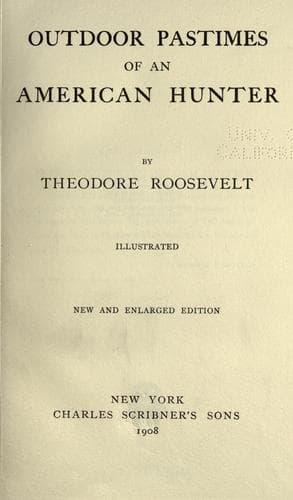
Outdoor pastimes of an American hunterRoosevelt, Theodore
General
Outdoor pastimes of an American hunter
Roosevelt, Theodore
Hunting -- United States; Hunting -- West (U.S.)
On April 8, 1903, John Burroughs and I reached the Yellowstone Park, and
were met by Major John Pitcher of the Regular Army, the Superintendent
of the Park. The Major and I forthwith took horses; he telling me that
he could show me a good deal of game while riding up to his house at the
Mammoth Hot Springs. Hardly had we left the little town of Gardiner and
gotten within the limits of the Park before we saw prongbuck. There was
a band of at least a hundred feeding some distance from the road. We
rode leisurely toward them. They were tame compared to their kindred in
unprotected places; that is, it was easy to ride within fair rifle range
of them; and though they were not familiar in the sense that we
afterwards found the bighorn and the deer to be familiar, it was
extraordinary to find them showing such familiarity almost literally in
the streets of a frontier town. It spoke volumes for the good sense and
law-abiding spirit of the people of the town. During the two hours
following my entry into the Park we rode around the plains and lower
slopes of the foothills in the neighborhood of the mouth of the Gardiner
and we saw several hundred—probably a thousand all told—of these
antelopes. Major Pitcher informed me that all the pronghorns in the Park
wintered in this neighborhood. Toward the end of April or the first of
May they migrate back to their summering homes in the open valleys along
the Yellowstone and in the plains south of the Golden Gate. While
migrating they go over the mountains and through forests if occasion
demands. Although there are plenty of coyotes in the Park, there are no
big wolves, and save for very infrequent poachers the only enemy of the
antelope, as indeed the only enemy of all the game, is the cougar.
[Illustration:
ANTELOPE IN THE STREETS OF GARDINER
]
Cougars, known in the Park, as elsewhere through the West,as “mountain
lions,” are plentiful, having increased in numbers of recent years.
Except in the neighborhood of the Gardiner River, that is within a few
miles of Mammoth Hot Springs, I found them feeding on elk, which in the
Park far outnumber all other game put together, being so numerous that
the ravages of the cougars are of no real damage to the herds. But in
the neighborhood of the Mammoth Hot Springs the cougars are noxious
because of the antelope, mountain sheep, and deer which they kill; and
the Superintendent has imported some hounds with which to hunt them.
These hounds are managed by Buffalo Jones, a famous old plainsman, who
is now in the Park taking care of the buffalo. On this first day of my
visit to the Park I came across the carcasses of a deer and of an
antelope which the cougars had killed. On the great plains cougars
rarely get antelope, but here the country is broken so that the big cats
can make their stalks under favorable circumstances. To deer and
mountain sheep the cougar is a most dangerous enemy—much more so than
the wolf.
Public-domain text, read in full here on John Shaqi.
Reviews
Reviews
No reviews yet
Be the first to share your thoughts on this work.
Elsewhere in the archive
Join the Discussion
Join the discussion
Sign in to leave a comment or review.
Sign InorCreate an account