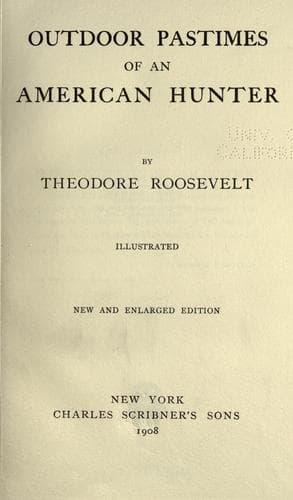
Outdoor pastimes of an American hunterRoosevelt, Theodore
General
Outdoor pastimes of an American hunter
Roosevelt, Theodore
Hunting -- United States; Hunting -- West (U.S.)
I am not disposed to undervalue manly outdoor sports, or to fail to
appreciate the advantage to a nation, as well as to an individual, of
such pastimes; but they must be pastimes, and not business, and they
must not be carried to excess. There is much to be said for the life of
a professional hunter in lonely lands; but the man able to be something
more, should be that something more—an explorer, a naturalist, or else a
man who makes his hunting trips merely delightful interludes in his life
work. As for excessive game-butchery, it amounts to a repulsive debauch.
The man whose chief title to glory is that, during an industrious career
of destruction, he has slaughtered 200,000 head of deer and partridges,
stands unpleasantly near those continental kings and nobles who, during
the centuries before the French Revolution, deified the chase of the
stag, and made it into a highly artificial cult, which they followed to
the exclusion of State-craft and war-craft and everything else. James,
the founder of the ignoble English branch of the Stuart kings, as
unkingly a man as ever sat on a throne, was fanatical in his devotion to
the artificial kind of chase which then absorbed the souls of the
magnates of continental Europe.
There is no need to exercise much patience with men who protest against
field sports, unless, indeed, they are logical vegetarians of the
flabbiest Hindoo type. If no deer or rabbits were killed, no crops could
be cultivated. If it is morally right to kill an animal to eat its body,
then it is morally right to kill it to preserve its head. A good
sportsman will not hesitate as to the relative value he puts upon the
two, and to get the one he will go a long time without eating the other.
No nation facing the unhealthy softening and relaxation of fibre which
tend to accompany civilization can afford to neglect anything that will
develop hardihood, resolution, and the scorn of discomfort and danger.
But if sport is made an end instead of a means, it is better to avoid it
altogether. The greatest stag-hunter of the seventeenth century was the
Elector of Saxony. During the Thirty Years’ War he killed some 80,000
deer and boar. Now, if there ever was a time when a ruler needed to
apply himself to serious matters, it was during the Thirty Years’ War in
Germany, and if the Elector in question had eschewed hunting he might
have compared more favorably with Gustavus Adolphus in his own
generation, or the Great Elector of Brandenburg in the next generation.
The kings of the House of Savoy have shown that the love of hardy field
sports in no way interferes with the exercise of the highest kind of
governmental ability.
Public-domain text, read in full here on John Shaqi.
Reviews
Reviews
No reviews yet
Be the first to share your thoughts on this work.
Elsewhere in the archive