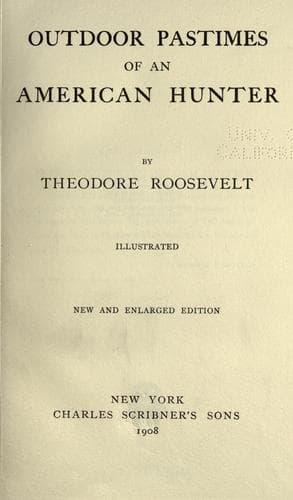
Outdoor pastimes of an American hunterRoosevelt, Theodore
General
Outdoor pastimes of an American hunter
Roosevelt, Theodore
Hunting -- United States; Hunting -- West (U.S.)
The Audubon Society and kindred organizations have done much for the
proper protection of birds and of wild creatures generally; they have
taken the lead in putting a stop to wanton or short-sighted destruction,
and in giving effective utterance to the desires of those who wish to
cultivate a spirit as far removed as possible from that which brings
about such destruction. Sometimes, however, in endeavoring to impress
upon a not easily aroused public the need for action, they in their zeal
overstate this need. This is a very venial error compared to the good
they have done; but in the interest of scientific accuracy it is to be
desired that their cause should not be buttressed in such manner. Many
of our birds have diminished lamentably in numbers, and there is every
reason for taking steps to preserve them. There are water birds, shore
birds, game birds, and an occasional conspicuous bird of some other
kind, which can only be preserved by such agitation. It is also most
desirable to prevent the slaughter of small birds in the neighborhood of
towns. But I question very much whether there has been any diminution of
small-bird life throughout the country at large. Certainly no such
diminution has taken place during the past thirty years in any region of
considerable size with which I am personally acquainted. Take Long
Island, for instance. During this period there has been a lamentable
decrease in the waders—the shore-birds—which used to flock along its
southern shore. But in northern Long Island, in the neighborhood of my
own home, birds, taken as a whole, are quite as plentiful as they were
when I was a boy. There are one or two species which have decreased in
numbers, notably the woodcock; while the passenger pigeon, which was
then a rarely seen straggler, does not now appear at all. Bobwhites are
less plentiful. On the other hand, some birds have certainly increased
in numbers. This is true, for instance, of the conspicuously beautiful
and showy scarlet tanager. I think meadow larks are rather more
plentiful than they were, and wrens less so. Bluebirds have never been
common with us, but are now rather more common than formerly. It seems
to me as if the chickadees were more numerous than formerly. Purple
grackles are more plentiful than when I was a boy, and the far more
attractive redwing blackbirds less so. But these may all be, and
doubtless some must be, purely local changes, which apply only to our
immediate neighborhood. As regards most of the birds, it would be hard
to say that there has been any change. Of course, obvious local causes
will now and then account for a partial change. Thus, while the little
green herons are quite as plentiful as formerly in our immediate
neighborhood, the white-crowned night herons are not as plentiful,
because they abandoned their big heronry on Lloyd’s Neck upon the
erection of a sand-mill close by. The only ducks which are now, or at
any time during the last thirty years have been, abundant in our
Public-domain text, read in full here on John Shaqi.
Reviews
Reviews
No reviews yet
Be the first to share your thoughts on this work.
Elsewhere in the archive
Join the Discussion
Join the discussion
Sign in to leave a comment or review.
Sign InorCreate an account