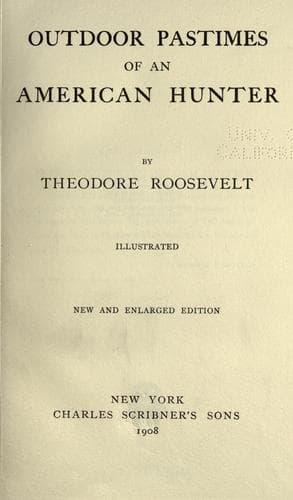
Outdoor pastimes of an American hunterRoosevelt, Theodore
General
Outdoor pastimes of an American hunter
Roosevelt, Theodore
Hunting -- United States; Hunting -- West (U.S.)
As a steady thing, the children found rabbits and guinea pigs the most
satisfactory pets. The guinea pigs usually rejoiced in the names of the
local or national celebrities of the moment; at one time there were
five, which were named after naval heroes and friendly ecclesiastical
dignitaries—an Episcopalian Bishop, a Catholic Priest, and my own Dutch
Reformed Pastor—Bishop Doane, Father O’Grady, Dr. Johnson, Fighting Bob
Evans, and Admiral Dewey. Father O’Grady, by the way, proved to be of
the softer sex; a fact definitely established when two of his joint
owners, rushing breathless into the room, announced to a mixed company,
“Oh, oh, Father O’Grady has had some children!”
Of course there are no pets like horses; and horsemanship is a test of
prowess. The best among vigorous out-of-door sports should be more than
pastimes. Play is good for play’s sake, within moderate limits,
especially if it is athletic play; and, again within moderate limits, it
is good because a healthy body helps toward healthiness of mind. But if
play serves only either of these ends, it does not deserve the serious
consideration which rightly attaches to play which in itself fits a man
to do things worth doing; and there exists no creature much more
contemptible than a man past his first youth who leads a life devoted to
mere sport, without thought of the serious work of life. In a free
Government the average citizen should be able to do his duty in war as
well as in peace; otherwise he falls short. Cavalrymen and infantrymen,
who do not need special technical knowledge, are easily developed out of
men who are already soldiers in the rough, that is, who, in addition to
the essential qualities of manliness and character, the qualities of
resolution, daring and intelligence, which go to make up the “fighting
edge,” also possess physical hardihood; who can live in the open, walk
long distances, ride, shoot, and endure fatigue, hardship, and exposure.
But if all these traits must be painfully acquired, then it takes a long
time indeed before the man can be turned into a good soldier. Now, there
is little tendency to develop these traits in our highly complex, rather
over-civilized, modern industrial life, and therefore the sports which
produce them serve a useful purpose. Hence, when able to afford a horse,
or to practise on a rifle range, one can feel that the enjoyment is
warranted by what may be called considerations of national ethics.
Public-domain text, read in full here on John Shaqi.
Reviews
Reviews
No reviews yet
Be the first to share your thoughts on this work.
Elsewhere in the archive
Join the Discussion
Join the discussion
Sign in to leave a comment or review.
Sign InorCreate an account