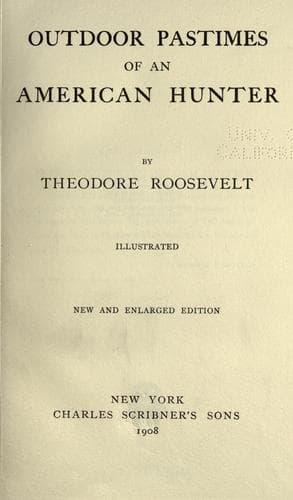
Outdoor pastimes of an American hunterRoosevelt, Theodore
General
Outdoor pastimes of an American hunter
Roosevelt, Theodore
Hunting -- United States; Hunting -- West (U.S.)
But no bears were to be found. We waited long hours on likely stands. We
rode around the canebrakes through the swampy jungle, or threaded our
way across them on trails cut by the heavy wood-knives of my companions;
but we found nothing. Until the trails were cut the canebrakes were
impenetrable to a horse and were difficult enough to a man on foot. On
going through them it seemed as if we must be in the tropics; the
silence, the stillness, the heat, and the obscurity, all combining to
give a certain eeriness to the task, as we chopped our winding way
slowly through the dense mass of close-growing, feather-fronded stalks.
Each of the hunters prided himself on his skill with the horn, which was
an essential adjunct of the hunt, used both to summon and control the
hounds, and for signalling among the hunters themselves. The tones of
many of the horns were full and musical; and it was pleasant to hear
them as they wailed to one another, backward and forward, across the
great stretches of lonely swamp and forest.
A few days convinced us that it was a waste of time to stay longer where
we were. Accordingly, early one morning we hunters started for a new
camp fifteen or twenty miles to the southward, on Bear Lake. We took the
hounds with us, and each man carried what he chose or could in his
saddle-pockets, while his slicker was on his horse’s back behind him.
Otherwise we took absolutely nothing in the way of supplies, and the
negroes with the tents and camp equipage were three days before they
overtook us. On our way down we were joined by Major Amacker and Dr.
Miller, with a small pack of cat hounds. These were good deer dogs, and
they ran down and killed on the ground a good-sized bobcat—a wildcat, as
it is called in the South. It was a male and weighed twenty-three and a
half pounds. It had just killed and eaten a large rabbit. The stomachs
of the deer we killed, by the way, contained acorns and leaves.
Our new camp was beautifully situated on the bold, steep bank of Bear
Lake—a tranquil stretch of water, part of an old river bed, a couple of
hundred yards broad with a winding length of several miles. Giant
cypress grew at the edge of the water; the singular cypress knees rising
in every direction round about, while at the bottoms of the trunks
themselves were often cavernous hollows opening beneath the surface of
water, some of them serving as dens for alligators. There was a waxing
moon, so that the nights were as beautiful as the days.
Public-domain text, read in full here on John Shaqi.
Reviews
Reviews
No reviews yet
Be the first to share your thoughts on this work.
Elsewhere in the archive
Join the Discussion
Join the discussion
Sign in to leave a comment or review.
Sign InorCreate an account