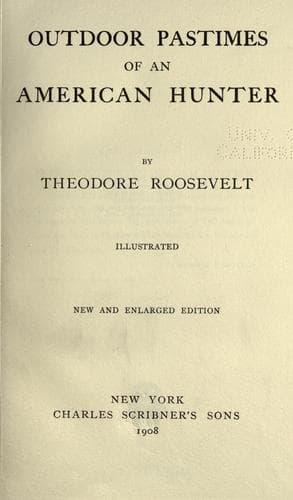
Outdoor pastimes of an American hunterRoosevelt, Theodore
General
Outdoor pastimes of an American hunter
Roosevelt, Theodore
Hunting -- United States; Hunting -- West (U.S.)
On reaching the cypress slough near which the tracks of the old she had
been seen the day before, Clive Metcalf and I separated from the others
and rode off at a lively pace between two of the canebrakes. After an
hour or two’s wait we heard, very far off, the notes of one of the
loudest-mouthed hounds, and instantly rode toward it, until we could
make out the babel of the pack. Some hard galloping brought us opposite
the point toward which they were heading,—for experienced hunters can
often tell the probable line of a bear’s flight, and the spots at which
it will break cover. But on this occasion the bear shied off from
leaving the thick cane and doubled back; and soon the hounds were once
more out of hearing, while we galloped desperately around the edge of
the cane. The tough woods-horses kept their feet like cats as they
leaped logs, plunged through bushes, and dodged in and out among the
tree trunks; and we had all we could do to prevent the vines from
lifting us out of the saddle, while the thorns tore our hands and faces.
Hither and thither we went, now at a trot, now at a run, now stopping to
listen for the pack. Occasionally we could hear the hounds, and then off
we would go racing through the forest toward the point toward which we
thought they were heading. Finally, after a couple of hours of this, we
came up on one side of a canebrake on the other side of which we could
hear, not only the pack, but the yelling and cheering of Harley Metcalf
and Tom Osborn and one or two of the negro hunters, all of whom were
trying to keep the dogs up to their work in the thick cane. Again we
rode ahead, and now in a few minutes were rewarded by hearing the
leading dogs come to bay in the thickest of the cover. Having galloped
as near to the spot as we could we threw ourselves off the horses and
plunged into the cane, trying to cause as little disturbance as
possible, but of course utterly unable to avoid making some noise.
Before we were within gunshot, however, we could tell by the sounds that
the bear had once again started, making what is called a “walking bay.”
Clive Metcalf, a finished bear-hunter, was speedily able to determine
what the bear’s probable course would be, and we stole through the cane
until we came to a spot near which he thought the quarry would pass.
Then we crouched down, I with my rifle at the ready. Nor did we have
long to wait. Peering through the thick-growing stalks I suddenly made
out the dim outline of the bear coming straight toward us; and
noiselessly I cocked and half-raised my rifle, waiting for a clearer
chance. In a few seconds it came; the bear turned almost broadside to
me, and walked forward very stiff-legged, almost as if on tiptoe, now
and then looking back at the nearest dogs. These were two in
number—Rowdy, a very deep-voiced hound, in the lead, and Queen, a
shrill-tongued brindled bitch, a little behind. Once or twice the bear
paused as she looked back at them, evidently hoping that they would come
Public-domain text, read in full here on John Shaqi.
Reviews
Reviews
No reviews yet
Be the first to share your thoughts on this work.
Elsewhere in the archive
Join the Discussion
Join the discussion
Sign in to leave a comment or review.
Sign InorCreate an account