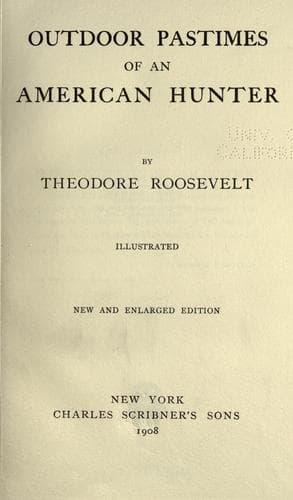
Outdoor pastimes of an American hunterRoosevelt, Theodore
General
Outdoor pastimes of an American hunter
Roosevelt, Theodore
Hunting -- United States; Hunting -- West (U.S.)
After the death of my bear I had only a couple of days left. We spent
them a long distance from camp, having to cross two bayous before we got
to the hunting grounds. I missed a shot at a deer, seeing little more
than the flicker of its white tail through the dense bushes; and the
pack caught and killed a very lean two-year-old bear weighing eighty
pounds. Near a beautiful pond called Panther Lake we found a deer-lick,
the ground not merely bare but furrowed into hollows by the tongues of
the countless generations of deer that had frequented the place. We also
passed a huge mound, the only hillock in the entire district; it was the
work of man, for it had been built in the unknown past by those unknown
people whom we call moundbuilders. On the trip, all told, we killed and
brought into camp three bears, six deer, a wildcat, a turkey, a possum,
and a dozen squirrels; and we ate everything except the wildcat.
In the evenings we sat around the blazing camp-fires, and, as always on
such occasions, each hunter told tales of his adventures and of the
strange feats and habits of the beasts of the wilderness. There had been
beaver all through this delta in the old days, and a very few are still
left in out-of-the-way places. One Sunday morning we saw two wolves, I
think young of the year, appear for a moment on the opposite side of the
bayou, but they vanished before we could shoot. All of our party had had
a good deal of experience with wolves. The Metcalfs had had many sheep
killed by them, the method of killing being invariably by a single bite
which tore open the throat while the wolf ran beside his victim. The
wolves also killed young hogs, but were very cautious about meddling
with an old sow; while one of the big half-wild boars that ranged free
through the woods had no fear of any number of wolves. Their endurance
and the extremely difficult nature of the country made it difficult to
hunt them, and the hunters all bore them a grudge, because if a hound
got lost in a region where wolves were at all plentiful they were almost
sure to find and kill him before he got home. They were fond of preying
on dogs, and at times would boldly kill the hounds right ahead of the
hunters. In one instance, while the dogs were following a bear and were
but a couple of hundred yards in front of the horsemen, a small party of
wolves got in on them and killed two. One of the Osborns, having a
valuable hound which was addicted to wandering in the woods, saved him
from the wolves by putting a bell on him. The wolves evidently suspected
a trap and would never go near the dog. On one occasion another of his
hounds got loose with a chain on, and they found him a day or two
afterward unharmed, his chain having become entangled in the branches of
a bush. One or two wolves had evidently walked around and around the
imprisoned dog, but the chain had awakened their suspicions and they had
not pounced on him. They had killed a yearling heifer a short time
Public-domain text, read in full here on John Shaqi.
Reviews
Reviews
No reviews yet
Be the first to share your thoughts on this work.
Elsewhere in the archive
Join the Discussion
Join the discussion
Sign in to leave a comment or review.
Sign InorCreate an account