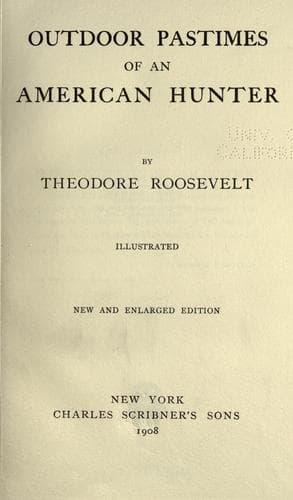
Outdoor pastimes of an American hunterRoosevelt, Theodore
General
Outdoor pastimes of an American hunter
Roosevelt, Theodore
Hunting -- United States; Hunting -- West (U.S.)
Mr. Charles Sheldon informs me that while on a ranch near Chihuahua he
at different times kept loose, as pets, a female cougar, three wolves,
and several coyotes, all taken when very young. All were exceedingly
tame and even affectionate, save at the moment of eating.
Mr. W. H. Wright, of Spokane, Wash., is a hunter of wide experience, and
has probably made as close a life study of the bear—particularly the
grizzly—as anyone now alive. In speaking to me, he dwells on its wide
variation in habits, not only as among individuals, but as between all
the individuals of one locality when compared with those of another.
Thus, in the Big Horn or the Teton Mountains if an animal is killed, he
has in his experience found that any grizzly within range is almost sure
to come to the carcass (and this has been my experience in the same
region). In the Bitter Roots, where the bears live largely on fish,
berries and roots, he found the chances just about even whether the
bears would or would not come; whereas in the Selkirks, he found that
the bears would very rarely pay any attention to a carcass, this being a
place where game is comparatively scarce and where there are no salmon,
so that the bears live exclusively as vegetarians, save for eating small
mammals or insects. In the Bitter Roots Mountains the bears used to live
chiefly on fish in the spring and early in the fall; in the summer they
fed to a large extent on the shooting star, which grows on all the
marshes and is one of the familiar plants of the region, but did not
touch either the dog-tooth violet or the spring beauty, both of which
have little tubers on the roots. But in the Kootenay country he found
that the bears dug up acres and acres of these very dog-tooth violets
and spring beauties for the sake of the bulbs on their roots; and that
they rarely or never touched the shooting stars. All this illustrates
the extreme care which should be taken in making observations and in
dogmatizing from insufficient data; and also the absolute necessity, if
a full and accurate natural history is to be written, of drawing upon
the experience of very many different observers—provided, of course,
that they are trustworthy observers.
Public-domain text, read in full here on John Shaqi.
Reviews
Reviews
No reviews yet
Be the first to share your thoughts on this work.
Elsewhere in the archive
Join the Discussion
Join the discussion
Sign in to leave a comment or review.
Sign InorCreate an account