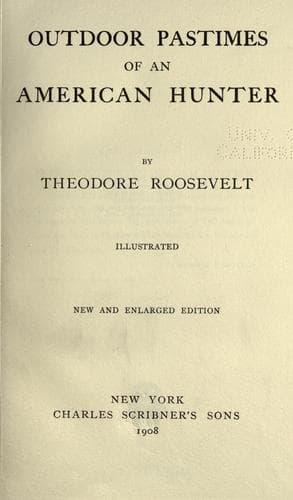
Outdoor pastimes of an American hunterRoosevelt, Theodore
General
Outdoor pastimes of an American hunter
Roosevelt, Theodore
Hunting -- United States; Hunting -- West (U.S.)
There is ample room for more complete life histories of many small
beasts that are common enough around our country homes; and fortunately
the need is now being met by various good field naturalists. Just last
summer, in mid-July, 1907, I had an entirely novel experience with
foxes, which illustrates how bold naturally shy creatures sometimes are
after nightfall. Some of the boys and I were camping for the night on
the beach by the Sound, under a clay bluff, having gone thither in the
dory and the two light rowing skiffs; it was about a quarter of a mile
from the place where we had seen the big red fox four or five years
previously. The fire burned all night, and one or other of the party
would now and then rise and stand by it; nevertheless, two young foxes,
evidently cubs of the year, came round the fire, within plain sight,
half a dozen times. They were picking up scraps; two or three times they
came within ten yards of the fire. They were very active, scampering up
the bluffs; and when in the bushes made a good deal of noise, whereas a
full-grown fox generally moves in silence even when in dead brush.
Small mammals, with the exception of squirrels, are so much less
conspicuous than birds, and indeed usually pass their lives in such
seclusion, that the ordinary observer is hardly aware of their presence.
At Sagamore Hill, for instance, except at haying time I rarely see the
swarming meadow mice, the much less plentiful pine mice, or the little
mole-shrews, alive, unless they happen to drop into a pit or sunken area
which has been dug at one point to let light through a window into the
cellar. The much more graceful and attractive white-footed mice and
jumping mice are almost as rarely seen, though if one does come across a
jumping mouse it at once attracts attention by its extraordinary leaps.
The jumping mouse hibernates, like the woodchuck; and so does the
chipmunk, though not always. The other little animals just mentioned are
abroad all winter, the meadow mice under the snow, the white-footed
mice, and often the shrews, above the snow. The tell-tale snow, showing
all the tracks, betrays the hitherto unsuspected existence of many
little creatures; and the commonest marks upon it are those of the
rabbit and especially of the white-footed mouse. The shrew walks or
trots and makes alternate footsteps in the snow. White-foot, on the
contrary, always jumps, whether going slow or fast, and his hind feet
leave their prints side by side, often with the mark where the tail has
dragged. I think white-foot is the most plentiful of all our furred wild
creatures, taken as a whole. He climbs trees well; I have found his nest
in an old vireo’s nest; but more often under stumps or boards. The
meadow mice often live in the marshes, and are entirely at home in the
water.
Public-domain text, read in full here on John Shaqi.
Reviews
Reviews
No reviews yet
Be the first to share your thoughts on this work.
Elsewhere in the archive
Join the Discussion
Join the discussion
Sign in to leave a comment or review.
Sign InorCreate an account