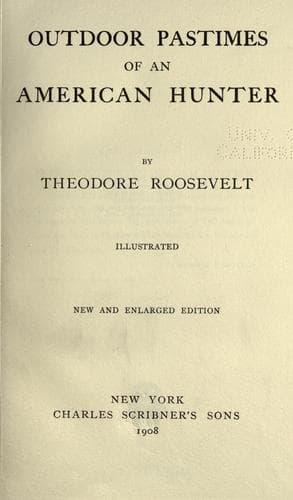
Outdoor pastimes of an American hunterRoosevelt, Theodore
General
Outdoor pastimes of an American hunter
Roosevelt, Theodore
Hunting -- United States; Hunting -- West (U.S.)
Shorty was always the first of the pack to attack dangerous game, and in
attacking bear or cougar even Badge was much less reckless and more
wary. In consequence, Shorty was seamed over with scars; most of them
from bobcats, but one or two from cougars. He could speedily kill a
bobcat single-handed; for these small lynxes are not really formidable
fighters, although they will lacerate a dog quite severely. Shorty found
a badger a much more difficult antagonist than a bobcat. A bobcat in a
hole makes a hard fight, however. On this hunt we once got a bobcat
under a big rock, and Jake’s Rowdy in trying to reach it got so badly
mauled that he had to join the invalid class for several days.
The bobcat we killed this first day was a male, weighing twenty-five
pounds. It was too late to try after the bear, especially as we had only
ten or a dozen dogs out, while the bear’s tracks showed it to be a big
one; and we rode back to camp.
Next morning we rode off early, taking with us all twenty-six hounds and
the four terriers. We wished first to find whether the bear had gone out
of the country in which we had seen him, and so rode up a valley and
then scrambled laboriously up the mountain-side to the top of the
snow-covered divide. Here the snow was three feet deep in places, and
the horses plunged and floundered as we worked our way in single file
through the drifts. But it had frozen hard the previous night, so that a
bear could walk on the crust and leave very little sign. In consequence
we came near passing over the place where the animal we were after had
actually crossed out of the canyon-like ravine in which we had seen him
and gone over the divide into another set of valleys. The trail was so
faint that it puzzled us, as we could not be certain how fresh it was,
and until this point could be cleared up we tried to keep the hounds
from following it. Old Jim, however, slipped off to one side and
speedily satisfied himself that the trail was fresh. Along it he went,
giving tongue, and the other dogs were maddened by the sound, while Jim,
under such circumstances, paid no heed whatever to any effort to make
him come back. Accordingly, the other hounds were slipped after him, and
down they ran into the valley, while we slid, floundered, and scrambled
along the ridge crest parallel to them, until a couple of miles farther
on we worked our way down to some great slopes covered with dwarf
scrub-oak. At the edge of these slopes, where they fell off in abrupt
descent to the stream at the bottom of the valley, we halted. Opposite
us was a high and very rugged mountain-side covered with a growth of
pinyon—never a close-growing tree—its precipitous flanks broken by
ledges and scored by gullies and ravines. It was hard to follow the
scent across such a mountain-side, and the dogs speedily became much
scattered. We could hear them plainly, and now and then could see them,
looking like ants as they ran up and down hill and along the ledges.
Public-domain text, read in full here on John Shaqi.
Reviews
Reviews
No reviews yet
Be the first to share your thoughts on this work.
Elsewhere in the archive
Join the Discussion
Join the discussion
Sign in to leave a comment or review.
Sign InorCreate an account