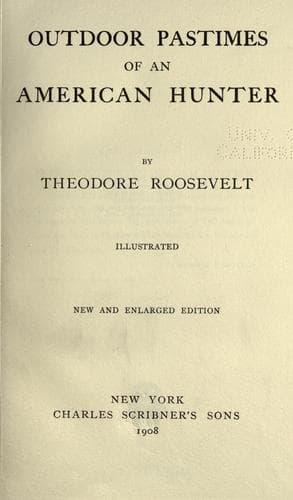
Outdoor pastimes of an American hunterRoosevelt, Theodore
General
Outdoor pastimes of an American hunter
Roosevelt, Theodore
Hunting -- United States; Hunting -- West (U.S.)
The bear was a big male, weighing three hundred and thirty pounds. On
examination at close quarters, his fur, which was in fine condition, was
not as black as it had seemed when seen afar off, the roots of the hairs
being brown. There was nothing whatever in his stomach. Evidently he had
not yet begun to eat, and had been but a short while out of his hole.
Bear feed very little when they first come out of their dens, sometimes
beginning on grass, sometimes on buds. Occasionally they will feed at
carcasses and try to kill animals within a week or two after they have
left winter quarters, but this is rare, and as a usual thing for the
first few weeks after they have come out they feed much as a deer would.
Although not hog fat, as would probably have been the case in the fall,
this bear was in good condition. In the fall, however, he would
doubtless have weighed over four hundred pounds. The three old females
we got on this trip weighed one hundred and eighty, one hundred and
seventy-five, and one hundred and thirty-five pounds apiece. The
yearlings weighed from thirty-one to forty pounds. The only other black
bears I ever weighed all belonged to the sub-species _Luteolus_, and
were killed on the Little Sunflower River, in Mississippi, in the late
fall of nineteen hundred and two. A big old male, in poor condition,
weighed two hundred and eighty-five pounds, and two very fat females
weighed two hundred and twenty and two hundred and thirty-five pounds
respectively.
The next few days we spent in hunting perseveringly, but unsuccessfully.
Each day we were from six to twelve hours in the saddle, climbing with
weary toil up the mountains and slipping and scrambling down them. On
the tops and on the north slopes there was much snow, so that we had to
pick our trails carefully, and even thus the horses often floundered
belly-deep as we worked along in single file; the men on the horses
which were best at snow bucking took turns in breaking the trail. In the
worst places we had to dismount and lead the horses, often over such bad
ground that nothing less sure-footed than the tough mountain ponies
could even have kept their legs. The weather was cold, with occasional
sharp flurries of snow, and once a regular snow-storm. We found the
tracks of one or two bears, but in each case several days old, and it
was evident either that the bears had gone back to their dens, finding
the season so late, or else that they were lying quiet in sheltered
places, and travelling as little as possible. One day, after a long run
of certainly five or six miles through very difficult country, the dogs
treed a bobcat in a big cedar. It had run so far that it was badly out
of breath. Stewart climbed the tree and took several photographs of it,
pushing the camera up to within about four feet of where the cat sat.
Lambert obtained photographs of both Stewart and the cat. Shorty was at
this time still an invalid from his encounter with the bear, but Skip
Public-domain text, read in full here on John Shaqi.
Reviews
Reviews
No reviews yet
Be the first to share your thoughts on this work.
Elsewhere in the archive
Join the Discussion
Join the discussion
Sign in to leave a comment or review.
Sign InorCreate an account