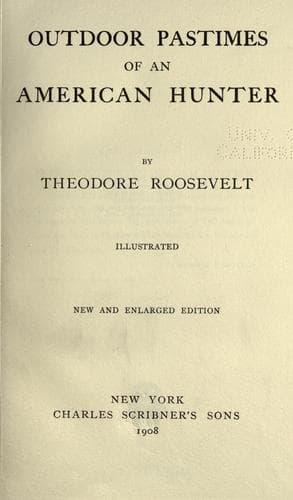
Outdoor pastimes of an American hunterRoosevelt, Theodore
General
Outdoor pastimes of an American hunter
Roosevelt, Theodore
Hunting -- United States; Hunting -- West (U.S.)
On April eighth, nineteen hundred and five, we left the town of
Frederick, Oklahoma, for a few days’ coyote coursing in the Comanche
Reserve. Lieut.-Gen. S. B. M. Young, U. S. A., retired, Lieutenant
Fortescue, U. S. A., formerly of my regiment, and Dr. Alexander Lambert,
of New York, were with me. We were the guests of Colonel Cecil Lyon, of
Texas, of Sloan Simpson, also of Texas, and formerly of my regiment, and
of two old-style Texas cattlemen, Messrs. Burnett and Wagner, who had
leased great stretches of wire-fenced pasture from the Comanches and
Kiowas; and I cannot sufficiently express my appreciation of the
kindness of these my hosts. Burnett’s brand, the Four Sixes, has been
owned by him for forty years. Both of them had come to this country
thirty years before, in the days of the buffalo, when all game was very
plentiful and the Indians were still on the warpath. Several other
ranchmen were along, including John Abernethy, of Tesca, Oklahoma, a
professional wolf hunter. There were also a number of cowhands of both
Burnett and Wagner; among them were two former riders for the Four
Sixes, Fi Taylor and Uncle Ed Gillis, who seemed to make it their
special mission to see that everything went right with me. Furthermore
there was Captain McDonald of the Texas Rangers, a game and true man,
whose name was one of terror to outlaws and violent criminals of all
kinds; and finally there was Quanah Parker, the Comanche chief, in his
youth a bitter foe of the whites, now painfully teaching his people to
travel the white man’s stony road.
[Illustration:
STARTING TOWARDS THE WOLF GROUNDS
From a photograph, copyright, 1905, by Alexander Lambert, M.D.
]
We drove out some twenty miles to where camp was pitched in a bend of
Deep Red Creek, which empties into the Red River of the South.
Cottonwood, elm, and pecans formed a belt of timber along the creek; we
had good water, the tents were pitched on short, thick grass, and
everything was in perfect order. The fare was delicious. Altogether it
was an ideal camp, and the days we passed there were also ideal.
Cardinals and mocking-birds—the most individual and delightful of all
birds in voice and manner—sang in the woods; and the beautiful,
many-tinted fork-tailed fly-catchers were to be seen now and then,
perched in trees or soaring in curious zigzags, chattering loudly.
Public-domain text, read in full here on John Shaqi.
Reviews
Reviews
No reviews yet
Be the first to share your thoughts on this work.
Elsewhere in the archive
Join the Discussion
Join the discussion
Sign in to leave a comment or review.
Sign InorCreate an account