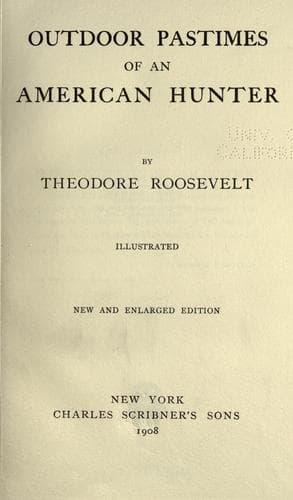
Outdoor pastimes of an American hunterRoosevelt, Theodore
General
Outdoor pastimes of an American hunter
Roosevelt, Theodore
Hunting -- United States; Hunting -- West (U.S.)
The coursing was done on the flats and great rolling prairies which
stretched north from our camp toward the Wichita Mountains and south
toward the Red River. There was a certain element of risk in the
gallops, because the whole country was one huge prairie-dog town, the
prairie-dogs being so numerous that the new towns and the abandoned
towns were continuous with one another in every direction. Practically
every run we had was through these prairie-dog towns, varied
occasionally by creeks and washouts. But as we always ran scattered out,
the wonderfully quick cow-ponies, brought up in this country and
spending all their time among the prairie-dog towns, were able, even
while running at headlong speed, to avoid the holes with a cleverness
that was simply marvellous. During our hunt but one horse stepped in a
hole; he turned a complete somerset, though neither he nor his rider was
hurt. Stunted mesquite bushes grew here and there in the grass, and
there was cactus. As always in prairie-dog towns, there were burrowing
owls and rattlesnakes. We had to be on our guard that the dogs did not
attack the latter. Once we thought a greyhound was certainly bitten. It
was a very fast blue bitch, which seized the rattler and literally shook
it to pieces. The rattler struck twice at the bitch, but so quick were
the bitch’s movements that she was not hit either time, and in a second
the snake was not merely dead, but in pieces. We usually killed the
rattlers with either our quirts or ropes. One which I thus killed was
over five feet long.
By rights there ought to have been carts in which the greyhounds could
be drawn until the coyotes were sighted, but there were none, and the
greyhounds simply trotted along beside the horses. All of them were fine
animals, and almost all of them of recorded pedigree. Coyotes have sharp
teeth and bite hard, while greyhounds have thin skins, and many of them
were cut in the worries. This was due to the fact that only two or three
of them seized by the throat, the others taking hold behind, which of
course exposed them to retaliation. Few of them would have been of much
use in stopping a big wolf. Abernethy’s hounds, however, though they
could not kill a big wolf, would stop it, permitting their owner to
seize it exactly as he seized coyotes, as hereafter described. He had
killed but a few of the big gray wolves; one weighed ninety-seven
pounds. He said that there were gradations from this down to the
coyotes. A few days before our arrival, after a very long chase, he had
captured a black wolf, weighing between fifty and sixty pounds.
Public-domain text, read in full here on John Shaqi.
Reviews
Reviews
No reviews yet
Be the first to share your thoughts on this work.
Elsewhere in the archive
Join the Discussion
Join the discussion
Sign in to leave a comment or review.
Sign InorCreate an account