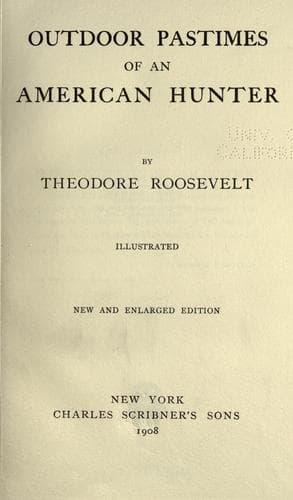
Outdoor pastimes of an American hunterRoosevelt, Theodore
General
Outdoor pastimes of an American hunter
Roosevelt, Theodore
Hunting -- United States; Hunting -- West (U.S.)
Between the runs we shogged forward across the great reaches of rolling
prairie in the bright sunlight. The air was wonderfully clear, and any
object on the sky-line, no matter how small, stood out with startling
distinctness. There were few flowers on these dry plains; in sharp
contrast to the flower prairies of southern Texas, which we had left the
week before, where many acres for a stretch would be covered by masses
of red or white or blue or yellow blossoms—the most striking of all,
perhaps, being the fields of the handsome buffalo clover. As we plodded
over the prairie the sharp eyes of the punchers were scanning the ground
far and near, and sooner or later one of them would spy the motionless
form of a coyote, or all would have their attention attracted as it ran
like a fleeting gray or brown shadow among the grays and browns of the
desolate landscape. Immediately dogs and horses would stretch at full
speed after it, and everything would be forgotten but the wild
exhilaration of the run.
[Illustration:
ABERNETHY AND COYOTE
From a photograph, copyright, 1905, by Alexander Lambert, M.D.
]
It was nearly noon when we struck the chuck wagon. Immediately the handy
round-up cook began to prepare a delicious dinner, and we ate as men
have a right to eat, who have ridden all the morning and are going to
ride fresh horses all the afternoon. Soon afterward the horse-wranglers
drove up the saddle band, while some of the cow-punchers made a rope
corral from the side of the wagon. Into this the horses were driven, one
or two breaking back and being brought into the bunch again only after a
gallop more exciting than most coyote chases. Fresh ponies were roped
out and the saddle band again turned loose. The dogs that had been used
during the morning then started campward with the chuck wagon. One of
the punchers was riding a young and partially broken horse; he had no
bridle, simply a rope around the horse’s neck. This man started to
accompany the wagon to the camp.
Public-domain text, read in full here on John Shaqi.
Reviews
Reviews
No reviews yet
Be the first to share your thoughts on this work.
Elsewhere in the archive
Join the Discussion
Join the discussion
Sign in to leave a comment or review.
Sign InorCreate an account