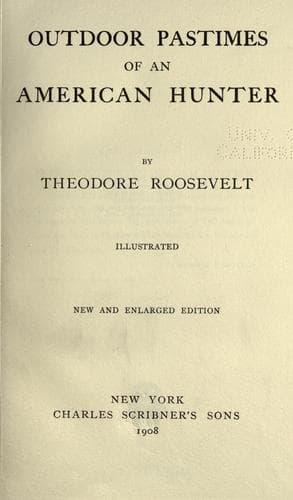
Outdoor pastimes of an American hunterRoosevelt, Theodore
General
Outdoor pastimes of an American hunter
Roosevelt, Theodore
Hunting -- United States; Hunting -- West (U.S.)
On this hunt we did not see any of the big wolves, the so-called buffalo
or timber wolves, which I hunted in the old days on the Northern cattle
plains. Big wolves are found in both Texas and Oklahoma, but they are
rare compared to the coyotes; and they are great wanderers. Alone or in
parties of three or four or half a dozen they travel to and fro across
the country, often leaving a district at once if they are molested.
Coyotes are more or less plentiful everywhere throughout the West in
thinly settled districts, and they often hang about in the immediate
neighborhood of towns. They do enough damage to make farmers and
ranchers kill them whenever the chance offers. But this damage is not
appreciable when compared with the ravages of their grim big brother,
the gray wolf, which, wherever it exists in numbers, is a veritable
scourge to the stockmen.
Colonel Lyon’s hounds were, as I have said, used chiefly after
jack-rabbits. He had frequently killed coyotes with them, however, and
on two or three occasions one of the big gray wolves. At the time when
he did most of his wolf-hunting he had with the greyhounds a huge
fighting dog, a Great Dane, weighing one hundred and forty-five pounds.
In spite of its weight this dog could keep up well in a short chase, and
its ferocious temper and enormous weight and strength made it invaluable
at the bay. Whether the quarry were a gray wolf or coyote mattered not
in the least to it, and it made its assaults with such headlong fury
that it generally escaped damage. On the two or three occasions when the
animal bayed was a big wolf the greyhounds did not dare tackle it,
jumping about in an irregular circle and threatening the wolf until the
fighting dog came up. The latter at once rushed in, seizing its
antagonist by the throat or neck and throwing it. Doubtless it would
have killed the wolf unassisted, but the greyhounds always joined in the
killing; and once thrown, the wolf could never get on his legs. In these
encounters the dog was never seriously hurt. Rather curiously, the only
bad wound it ever received was from a coyote; the little wolf, not
one-third of its weight, managing to inflict a terrific gash down its
huge antagonist’s chest, nearly tearing it open. But of course a coyote
against such a foe could not last much longer than a rat pitted against
a terrier.
Big wolves and coyotes are found side by side throughout the Western
United States, both varying so in size that if a sufficient number of
specimens, from different localities, are examined it will be found that
there is a complete intergradation in both stature and weight. To the
northward the coyotes disappear, and the big wolves grow larger and
larger until in the arctic regions they become veritable giants. At
Point Barrow Mr. E. A. McIlhenny had six of the eight “huskies” of his
dog team killed and eaten by a huge white dog wolf. At last he shot it,
and found that it weighed one hundred and sixty-one pounds.
Public-domain text, read in full here on John Shaqi.
Reviews
Reviews
No reviews yet
Be the first to share your thoughts on this work.
Elsewhere in the archive
Join the Discussion
Join the discussion
Sign in to leave a comment or review.
Sign InorCreate an account