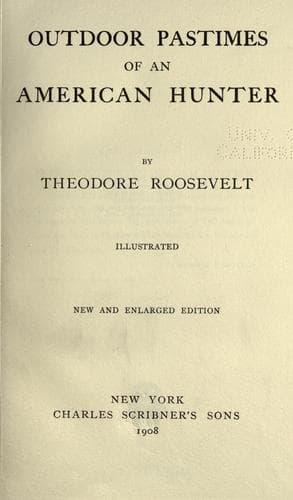
Outdoor pastimes of an American hunterRoosevelt, Theodore
General
Outdoor pastimes of an American hunter
Roosevelt, Theodore
Hunting -- United States; Hunting -- West (U.S.)
But with all wild animals, it is a noticeable fact that a course of
contact with man continuing over many generations of animal life causes
a species so to adapt itself to its new surroundings that it can hold
its own far better than formerly. When white men take up a new country,
the game, and especially the big game, being entirely unused to contend
with the new foe, succumb easily, and are almost completely killed out.
If any individuals survive at all, however, the succeeding generations
are far more difficult to exterminate than were their ancestors, and
they cling much more tenaciously to their old homes. The game to be
found in old and long-settled countries is of course much more wary and
able to take care of itself than the game of an untrodden wilderness; it
is the wilderness life, far more than the actual killing of the
wilderness game, which tests the ability of the wilderness hunter.
[Illustration:
ABERNETHY RETURNS FROM THE HUNT
From a photograph, copyright, 1905, by Alexander Lambert, M.D.
]
After a time, game may even, for the time being, increase in certain
districts where settlements are thin. This was true of the wolves
throughout the northern cattle country, in Montana, Wyoming, Colorado,
and the western ends of the Dakotas. In the old days wolves were very
plentiful throughout this region, closely following the huge herds of
buffaloes. The white men who followed these herds as professional
buffalo-hunters were often accompanied by other men, known as wolfers,
who poisoned these wolves for the sake of their fur. With the
disappearance of the buffalo the wolves diminished in numbers so that
they also seemed to disappear. Then in the late eighties or early
nineties the wolves began again to increase in numbers until they became
once more as numerous as ever and infinitely more wary and difficult to
kill; though as they were nocturnal in their habits they were not often
seen. Along the Little Missouri and in many parts of Montana and Wyoming
this increase was very noticeable during the last decade of the
nineteenth century. They were at that time the only big animals of the
region which had increased in numbers. Such an increase following a
previous decrease in the same region was both curious and interesting. I
never knew the wolves to be so numerous or so daring in their assaults
upon stock in the Little Missouri country as in the years 1894 to 1896
inclusive. I am unable wholly to account for these changes. The first
great diminution in the numbers of the wolves is only partially to be
explained by the poisoning; yet they seemed to disappear almost
everywhere and for a number of years continued scarce. Then they again
became plentiful, reappearing in districts from whence they had entirely
vanished, and appearing in new districts where they had been hitherto
unknown. Then they once more began to diminish in number. In
northwestern Colorado, in the White River country, cougars fairly
Public-domain text, read in full here on John Shaqi.
Reviews
Reviews
No reviews yet
Be the first to share your thoughts on this work.
Elsewhere in the archive
Join the Discussion
Join the discussion
Sign in to leave a comment or review.
Sign InorCreate an account