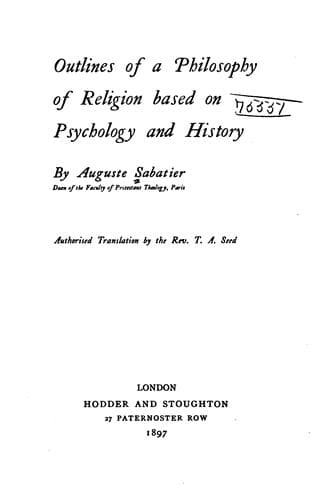
The doctrine of the sovereign authority of Scripture in matters of
faith might seem at first sight to set up an external authority. And
it is very true that certain Protestants have often understood it in
the Catholic sense, and have employed it to exercise some violence on
their own conscience or on the conscience of their brethren. But they
never succeed for long; they soon fall into a too flagrant
contradiction. The authority of the Bible is never separated in
Protestantism from the right of the individual to interpret it freely,
and from the personal duty of assimilating the truths he discovers in
it. What therefore are those Protestants doing who attempt to set up a
confession of faith as absolute and obligatory truth but imposing on
their brethren their own subjective interpretation, and, consequently,
denying to others the right which they exercise themselves? Nor let it
be forgotten, on the other hand, that the obligation laid on each
Christian to read the Bible and draw from it his faith is a perpetual
and fruitful appeal to the energy of thought and to the autonomy of the
inner life. The authority of Scripture, so far from being a menace to
Christian liberty, is its invincible rampart. Not only has the
Protestant Christian in the name of the Bible triumphed over eighteen
centuries of tradition, but it is the Bible, an appeal to the Bible
ever better understood, which has saved Protestant theology from
scholasticism, which has prevented it from congealing in a confession
of faith, and which, leaving the principle of the Gospel in an ideal
transcendence in relation to all its historical expressions or
realisations, has maintained, and still maintains, the spirit of reform
in the Churches of the Reformation.
Public-domain text, read in full here on John Shaqi.
Reviews
Reviews
No reviews yet
Be the first to share your thoughts on this work.
Elsewhere in the archive
Join the Discussion
Join the discussion
Sign in to leave a comment or review.
Sign InorCreate an account