To this question teleology alone responds. But every teleological
affirmation respecting the universe is a religious affirmation.
Science, studying only accomplished facts, never establishes anything
but phenomena and their antecedent or concomitant conditions. Once the
phenomenon is integrated in the causal series, the task of science is
accomplished. To ask it to go further is to ask it to go beyond its
limits and to denaturalise itself. You can only put teleology into the
universe by affirming the sovereignty of spirit. To say that there is
reason, that there is thought, in things--that they move towards an end
or realise an order, a harmony, a good: this is to say that matter is
subordinate to spirit. Now, to affirm this sovereignty of spirit is to
commit that act of initial religious faith of which I spoke at the
beginning; it is to feel in one's self and in the world something
besides matter, the mysterious energy of spirit. This act of
faith--legitimate because inevitable--belongs to the subjective order
of religious life, not to the objective order of science. Teleology
and the theory of final causes have been compromised because their
specific character has been mistaken; they have sometimes been
assimilated to, and sometimes substituted for, mechanical causes in the
explanation of phenomena. For an unknown scientific explanation has
been substituted an appeal to a supernatural intention or volition of
God. The savants rightly protested against this. God, who is the
final reason of everything, is the scientific explanation of nothing.
The object of science is to search for second causes; where these do
not appear there is no science. It is faith which replaces it. To say
that God created the world, or that the world tends toward the
sovereign good, is not to advance positive science a single step. On
the other hand, to explain the phenomena of rain, or thunder, or the
fall of bodies, is to dissipate some mythological conceptions; but it
is not to suppress the religious affirmation of spirit that the
mechanism of the universe has an end, and that the laws of gravitation
and the material forces serve some purpose of which they are ignorant,
and which is of more value than themselves.
Between the discoveries of science and the postulates of the religious
and moral life there is always necessarily formed a synthesis which is
destroyed at each step, but which rises again higher and larger than
before. Mechanism itself, in order to be intelligible, calls for
teleology. The text of the material world awaits the interpretation
that spirit gives of it. By its discoveries positive science
establishes the text. Without this rigorous establishment of the text,
the exegesis of consciousness remains a phantasy. But, without that
exegesis, the text itself signifies nothing; it is almost as if it did
not exist.
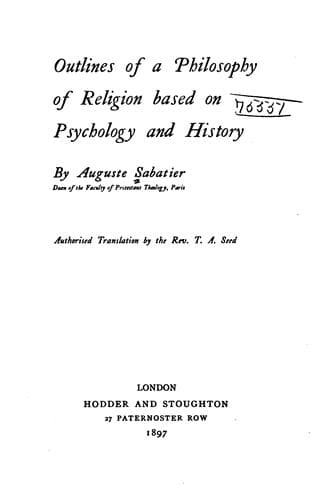
Public-domain text, read in full here on John Shaqi.
Reviews
Reviews
No reviews yet
Be the first to share your thoughts on this work.
Elsewhere in the archive
Join the Discussion
Join the discussion
Sign in to leave a comment or review.
Sign InorCreate an account