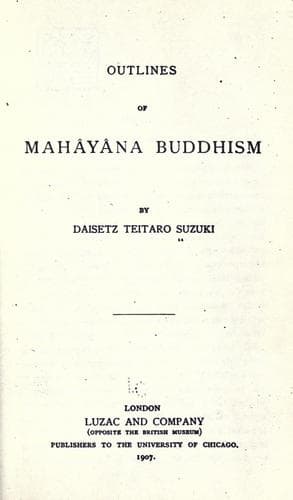
Outlines of Mahayana BuddhismSuzuki, Daisetz Teitaro
Religion
Outlines of Mahayana Buddhism
Suzuki, Daisetz Teitaro
Mahayana Buddhism -- Doctrines
Here, if not anywhere else, looms up most conspicuously the
characteristic difference between Buddhism and Christianity as to
their conception of soul-activity. Christianity, if I understand it
rightly, conceives our soul-phenomena as the work of an {212}
individual ego-entity, which keeps itself mysteriously hidden
somewhere within the body. To Christians, the soul is a metaphysical
being, and its incarnation in the flesh is imprisonment. It groans
after emancipation, it craves for the celestial abode, where, after
bodily death, it can enjoy all the blessings due to its naked
existence. It finds the nectar of immortality up in Heaven and in the
presence of God the father and Christ the son, and not in the
perpetuation of karma in this universe. The soul of the wicked, on the
other hand, is eternally damned, if it is conceded that they have any
soul. As soon as it is liberated from the bodily incarceration, it is
hurled into the infernal fire, and is there consumed suffering
unspeakable agony. Christianity, therefore, does not believe in the
transmigration or reincarnation of a soul. A soul once departed from
the flesh never returns to it; it is either living an eternal life in
Heaven or suffering an instant annihilation in Hell. This is the
necessary conclusion from their premises of an individual concrete
ego-soul.
Buddhism, however, does not teach the metaphysical existence of the
soul. All our mental and spiritual experiences, it declares, are due
to the operations of karma which inherits its efficiency from its
previous “seeds of activity” (_karmabîja_), and which has brought the
five skandhas into the present state of co-ordination. The present
karma, while in its force, generates in turn the “seeds of activity”
which under favorable conditions grow to maturity again. Therefore, as
long {213} as the force of karma is thus successively generated, there
are the five skandhas constantly coming into existence and working
co-ordinately as a person. Karma-reproduction, so to speak, effected
in this manner, is the Buddhist conception of the transmigration of a
soul.
Public-domain text, read in full here on John Shaqi.
Reviews
Reviews
No reviews yet
Be the first to share your thoughts on this work.
Elsewhere in the archive
Join the Discussion
Join the discussion
Sign in to leave a comment or review.
Sign InorCreate an account