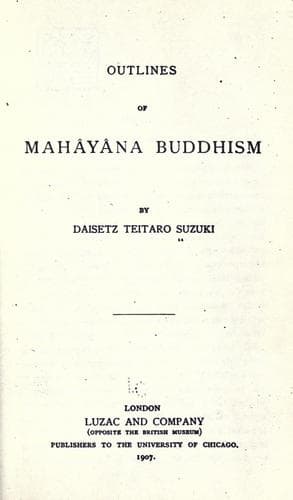
Outlines of Mahayana BuddhismSuzuki, Daisetz Teitaro
Religion
Outlines of Mahayana Buddhism
Suzuki, Daisetz Teitaro
Mahayana Buddhism -- Doctrines
“At this time the Bhagavat in the Double Tower of Chandana seated
himself in the assigned seat, entered upon a samâdhi, and displayed a
marvelous phenomenon. There appeared innumerable lotus-flowers with
thousand-fold petals and each flower as large as a carriage-wheel.
They had perfectly beautiful color and fragrant odour, but their
petals containing celestial beings in them were not yet unfolded. They
all were raised now by themselves high up in the heavens and hung over
the earth like a canopy of pearls. Each one of these lotus-flowers
emitted innumerable rays of light and simultaneously grew in size with
wonderful vitality. But through the divine power of Buddha they all of
{245} a sudden changed color and withered. All the celestial Buddhas
sitting cross-legged within the flowers now came into full view, shone
with innumerable hundred thousand-fold rays of light. At this moment
the transcendent glory of the spot was beyond description.”...
As is here thus clearly shown, the Buddha in the Mahâyâna scriptures
is not an ordinary human being walking in a sensuous world; he is
altogether dissimilar to that son of Suddhodana, who resigned the
royal life, wandered in the wilderness, and after six years’ profound
meditation and penance discovered the Fourfold Noble Truth and the
Twelve Chains of Dependence; and we cannot but think that the Mahâyâna
Buddha is the fictitious creation of an intensely poetic mind. Let it
be so. But the question which engages us now is, “How did the
Buddhists come to relegate the human Buddha to oblivion, as it were,
and assign a mysterious being in his place invested with all possible
or sometimes impossible majesty and supernaturality?” This question,
which marks the rise of Mahâyâna Buddhism, brings us to the doctrine
of Trikâya,--which in a sense corresponds to the Christian theory of
trinity.
According to this doctrine, the Buddhists presume a triple existence
of the Tathâgata, that is, the Tathâgata is conceived by them as
manifesting himself in three different forms of existence: the Body of
Transformation, the Body of Bliss, and the Body of Dharma. Though they
are conceived as three, they are in fact all the manifestations of one
Dharmakâya,--the Dharmakâya that revealed itself in the historical
Çâkyamuni {246} Buddha as a Body of Transformation, and in the Mahâyâna
Buddha as a Body of Bliss. However differently they may appear from
the human point of view, they are nothing but the expression of one
eternal truth, in which all things have their _raison d’être_.
_An Historical View._
Public-domain text, read in full here on John Shaqi.
Reviews
Reviews
No reviews yet
Be the first to share your thoughts on this work.
Elsewhere in the archive
Join the Discussion
Join the discussion
Sign in to leave a comment or review.
Sign InorCreate an account