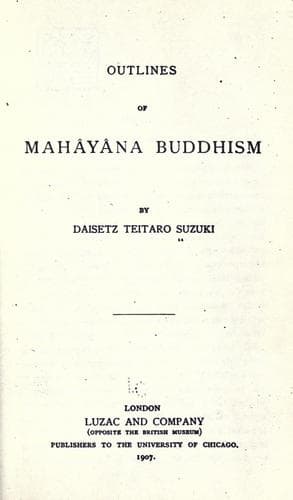
Outlines of Mahayana BuddhismSuzuki, Daisetz Teitaro
Religion
Outlines of Mahayana Buddhism
Suzuki, Daisetz Teitaro
Mahayana Buddhism -- Doctrines
The Mahâyânists now argue that the reason why Çâkyamuni entered into
Parinirvana when his worldly career was thought by him to be over is
that by this his resignation to the law of birth and death, he wished
to exemplify in him the impermanency of worldly life and the folly of
clinging to it as final reality. As for his Dharmakâya, it has an
eternal life, it was never born, and it would never perish; and when
called by the spiritual needs of the Bodhisattvas, it will cast off
the garb of absoluteness and preach in the form of a Sambhogakâya
“never-ceasing sermons which run like a stream for ever and aye.” It
will be evident from this that Buddhists are ready to consider all
religious or moral leaders of mankind, whatever their nationality, as
the Body of Transformation of the Dharmakâya. Translated into Christian
thoughts, God reveals himself in every being that is worthy of him. He
reveals himself not only at a certain {262} period in history, but
everywhere and all the time. His glory is perceived throughout all the
stages of human culture. This manifestation, from the very nature of
God, cannot be intermittent and sporadic as is imagined by some
“orthodox Christians.” The following from St. Paul’s first Epistle to
the Corinthians (Chap. XIII), when read in this connection, sounds
almost like a Buddhist philosopher’s utterance: “Now there are
diversities of gifts, but the same Spirit. And there are diversities
of administrations, but the same Lord. And there are diversities of
operations, but it is the same God which worketh all in all. But the
manifestation of the Spirit is given to every man to profit withal.
For to one is given by the Spirit the word of wisdom; to another the
word of knowledge by the same Spirit; to another faith by the same
Spirit; to another the gifts of healing by the same Spirit; to another
the working of miracles; to another prophecy; to another divers kinds
of tongues; to another the interpretation of tongues; but all these
worketh that one and the selfsame Spirit, dividing to every man
severally as he will. For as the body is one and hath many members,
and all the members of that one body, being many, are one body: so
also is Christ. For by one Spirit are we all baptised into one body,
whether we be Jews or Gentiles, whether we be bond or free; and have
been all made to drink into one Spirit.”
{263}
_The Sambhogakâya._
Public-domain text, read in full here on John Shaqi.
Reviews
Reviews
No reviews yet
Be the first to share your thoughts on this work.
Elsewhere in the archive
Join the Discussion
Join the discussion
Sign in to leave a comment or review.
Sign InorCreate an account