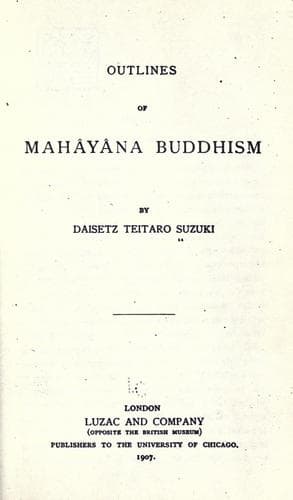
Outlines of Mahayana BuddhismSuzuki, Daisetz Teitaro
Religion
Outlines of Mahayana Buddhism
Suzuki, Daisetz Teitaro
Mahayana Buddhism -- Doctrines
These six peculiarities of the Body of Bliss as enumerated by Asanga
and Vasubandhu make it indeed entirely dependent on the Dharmakâya,
but they do not place us in any better position to penetrate into the
deep mystery of its nature. Its supernatural incomprehensibility
remains the same forever. In a certain sense, however, the Body of
Bliss may be considered to be corresponding to the Christian idea of
an angel. Supernaturalness and luminosity are the two characters
possessed by both, but angels are merely messengers of God
communicating the latter’s will to human beings. When they reveal
themselves to a specially favored person, it is not of their own {265}
account. When they speak to him at all, it is by the name of the being
who sent them. They do not represent him, they do not act his own will
by themselves. On the contrary, the Body of Bliss is the master of its
own. It is an expression of the Dharmakâya. It instructs and benefits
all the creatures who come to it. It acts according to its own will
and judgment. In these respects the Body of Bliss is altogether
different from the Christian conception of angels. But will it be more
appropriately compared to Christ in glory?
Let us make another quotation from later authorities than Asanga and
his brother Vasubandhu, and let us see more convincingly what
complicated notions are involved in the idea of the Body of Bliss.
According to the commentators on Vasubandhu’s _Vijñânamâtra Çâstra_
(a treatise on the Yoga philosophy),[114] the Body of Bliss has two
distinct aspects: (1) The body obtained by the Tathâgata for his
self-enjoyment, by dint of his religious discipline through eons; (2)
The body which the Tathâgata manifests to the {266} Bodhisattvas in
Pure Land (_sukhâvatî_). This last body is in possession of wonderful
spiritual powers, reveals the Wheel of Dharma, resolves all the
religious doubts raised by the Bodhisattvas, and lets them enjoy the
bliss of the Mahâyâna Dharma.
_A Mere Subjective Existence._
Public-domain text, read in full here on John Shaqi.
Reviews
Reviews
No reviews yet
Be the first to share your thoughts on this work.
Elsewhere in the archive
Join the Discussion
Join the discussion
Sign in to leave a comment or review.
Sign InorCreate an account