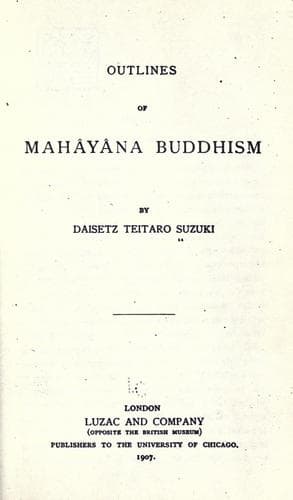
Outlines of Mahayana BuddhismSuzuki, Daisetz Teitaro
Religion
Outlines of Mahayana Buddhism
Suzuki, Daisetz Teitaro
Mahayana Buddhism -- Doctrines
The practical sequence of this doctrine of Trikâya is apparent; it
has ever more broadened the spirit of tolerance in Buddhists. As the
Dharmakâya universally responds to the spiritual needs of all sentient
beings in all times and in all places and at any stage of their
spiritual development, Buddhists consider all spiritual leaders,
whatever their nationality and personality, as the expressions of the
one omnipotent Dharmakâya. And as the Dharmakâya always manifests
itself for the best interests of sentient creatures, even those
doctrines and their authors that are apparently against the teachings
of Buddhism are tolerated through the conviction that they are all
moving according to the Spontaneous Will that pervades everywhere and
works all the time. Though, superficially, they may appear as evils,
their central and final aim is goodness and harmony which are destined
by the Will of the Dharmakâya to overcome this world of tribulations
and {276} contradictions. The general intellectual tendency of
Buddhism has done a great deal towards cultivating a tolerant spirit
in its believers, and we must say that the doctrine of Trinity which
appears sometimes too radical in its pantheistic spirit has
contributed much to this cause.
CHAPTER XI.
THE BODHISATTVA.
{277}
/Next/ to the conception of Buddha, what is important in Mahâyâna
Buddhism is that of Bodhisattva (intelligence-being) and of that which
constitutes its essence, Bodhicitta, intelligence-heart. As stated
above, the followers of Mahâyânism do not call themselves Çrâvakas
or Pratyekabuddhas or Arhats as do those of Hînayânism; but they
distinguish themselves by the title of Bodhisattva. What this means
will be the subject-matter of this chapter.
Let us begin with a quotation from the _Saddharma-pundarîka Sûtra_,
in which a well-defined distinction between the Çrâvakas and the
Pratyekabuddhas and the Bodhisattvas is given.[119]
_The Three Yânas._
“Now, Çâriputra, the beings who have become wise, have faith in the
Tathâgata, the father of the world, and consequently apply themselves
to his commandments.
“Amongst them there are some who, wishing to follow the dictate of an
authoritative voice, apply themselves to the commandment of the
Tathâgata to {278} acquire the knowledge of the Four Great Truths,
for the sake of their own complete Nirvana. These, one may say, to be
those who, seeking the vehicle of the Çrâvaka, fly from the triple
world.....
“Other beings desirous of the unconditioned knowledge, of
self-restraint and tranquillity, apply themselves to the commandment
of the Tathâgata to learn to understand the Twelve Chains of
Dependence, for the sake of their own complete Nirvana. These, one may
say, to be those who, seeking the vehicle of the Pratyekabuddha, fly
from the triple world.....
Public-domain text, read in full here on John Shaqi.
Reviews
Reviews
No reviews yet
Be the first to share your thoughts on this work.
Elsewhere in the archive
Join the Discussion
Join the discussion
Sign in to leave a comment or review.
Sign InorCreate an account