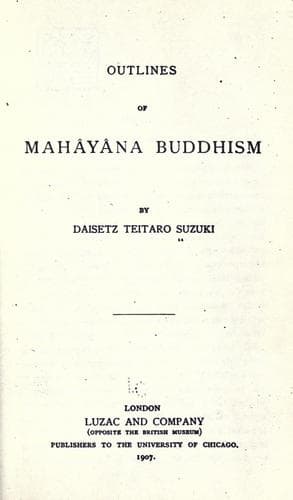
Outlines of Mahayana BuddhismSuzuki, Daisetz Teitaro
Religion
Outlines of Mahayana Buddhism
Suzuki, Daisetz Teitaro
Mahayana Buddhism -- Doctrines
The Buddhism of the Çrâvakas and the Pratyekabuddhas is the most
unscrupulous application to our ethico-religious life of the
individualistic theory of karma. All things done are done by oneself;
all things left undone are left undone by oneself. They would say:
“Your salvation is exclusively your own business, and whatever
sympathy I may have is of no avail. All that I can do toward helping
you is to let you see intellectually the way to emancipation. If you
do not follow it, you have but to suffer the fruition of your folly. I
am helpless with all my enlightenment, even with my Nirvana, to
emancipate you from the misery of perpetual metempsychosis.” But with
the Buddhism of the Mahâyâna Bodhisattvas the case is entirely
different. It is all-sympathy, it is all-compassion, it is all-love. A
Bodhisattva would not seclude himself into the absolute tranquillity
of Nirvana, simply because he wishes to emancipate his
fellow-creatures also from the bondage of ignorance and infatuation.
Whatever rewards he may get for his self-enjoyment as the karma of his
virtuous deeds, he would turn them over (_parivarta_) towards the
uplifting of the suffering masses. And this self-sacrifice, this
unselfish devotion to the welfare of his fellow-beings constitutes the
essence of Bodhisattvahood. The ideal Bodhisattva, therefore, is
thought to be no more than an incarnation of Intelligence and Love, of
Prajñâ and Karunâ.
The irrefragability of karma seems to be satisfactory {283} from the
intellectual and individualistic standpoint, for the intellect demands
a thorough application of logic, and individualism does not allow the
transferring of responsibility from one person to another. From this
viewpoint, therefore, a rigorous enforcement as demanded by Hînayânism
of the principle of self-emancipation does not show any logical fault;
divine grace must be suspended as the curse of karma produced by
ignorance tenaciously clings to our soul. But when viewed from the
religious side of the question, this inflexibility of karma is more
than poor mortals can endure. They want something more elastic and
pliable that yields to the supplication of the feeling. When
individuals are considered nothing but isolated, disconnected atoms,
between which there is no unifying bond which is the feeling, they are
too weak to resist and overcome the ever-threatening force of evil,
whose reality as long as a world of particulars exists cannot be
contradicted. This religious necessity felt in our inmost
consciousness may explain the reason why Mahâyâna Buddhism proposed
the doctrine of parivarta (turning over) founded on the oneness of
Dharmakâyâ.
_The Doctrine of Parivarta._
Public-domain text, read in full here on John Shaqi.
Reviews
Reviews
No reviews yet
Be the first to share your thoughts on this work.
Elsewhere in the archive
Join the Discussion
Join the discussion
Sign in to leave a comment or review.
Sign InorCreate an account