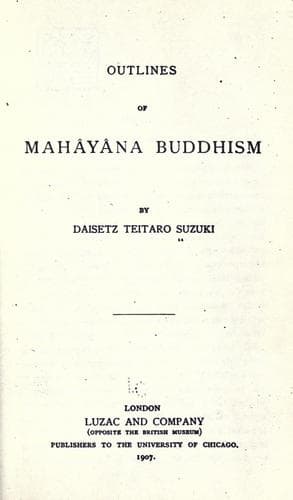
Outlines of Mahayana BuddhismSuzuki, Daisetz Teitaro
Religion
Outlines of Mahayana Buddhism
Suzuki, Daisetz Teitaro
Mahayana Buddhism -- Doctrines
“The Bodhisattvas do not feel, however, that they are being compelled
by any external force to devote their lives to the edification and
uplifting of the masses. They do not recognise any outward authority,
the violation of which may react upon them in the form of a punishment.
They have already passed beyond this stage of world-conception which
implies a dualism; they are on the contrary moving in a much wider and
higher sphere of thought. All that is done by them springs from their
spontaneous will, from the free activity of the Bodhicitta, which
constitutes their reason of existence; and thus there is nothing
compulsory in their thoughts and movements. [To use Laotzean
terminology, they are practising non-action, _wu wei_, and whatever
may appear to the ignorant and unenlightened as a strenuous and
restless life, is merely a natural {286} overflow from the
inexhaustible fount of energy called Bodhicitta, heart of
intelligence].”[121]
_Bodhisattva in “Primitive” Buddhism._
The notion of Bodhisattva was not entirely absent in “primitive”
Buddhism, only it did not have such a wide signification. All Buddhas
were Bodhisattvas in their former lives. The Jâtaka stories minutely
describe what self-sacrificing deeds were done by them and how by the
karma of these merits they finally attained Buddhahood. Çâkyamuni
was not the only Buddha, but there had already been seven or
twenty-four Buddhas prior to him, and the coming Buddha to be known as
Maitreya is believed to be disciplining himself in the Tuṣita heaven
and going through the stages of Bodhisattvahood. The one who is thus
destined to be the future Buddha must be extraordinarily gifted in
spiritual energy. He must pass through eons of self-discipline, must
practise deeds of non-atman with unflinching courage and fortitude
through innumerable existences.
The following quotation from the Jâtaka tales will be sufficient to
see what ponderous and exacting conditions were conceived by the
so-called Hînayânists to be necessary for a human being to become a
fully qualified Buddha.[122]
{287}
Public-domain text, read in full here on John Shaqi.
Reviews
Reviews
No reviews yet
Be the first to share your thoughts on this work.
Elsewhere in the archive
Join the Discussion
Join the discussion
Sign in to leave a comment or review.
Sign InorCreate an account