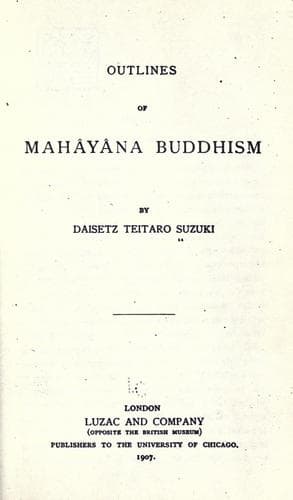
Outlines of Mahayana BuddhismSuzuki, Daisetz Teitaro
Religion
Outlines of Mahayana Buddhism
Suzuki, Daisetz Teitaro
Mahayana Buddhism -- Doctrines
Pramuditâ means “delight” or “joy” and marks the first stage of
Bodhisattvahood, at which the Buddhists emerge from a cold,
self-sufficing, and almost nihilistic contemplation of Nirvâna as
fostered by the Çrâvakas {314} and Pratyekabuddhas. This spiritual
emergence and emancipation is psychologically accompanied by an
intense feeling of joy, as that which is experienced by a person when
he unexpectedly recognises the most familiar face in a faraway land of
strangers. For this reason the first stage is called “joy.”
Even in the midst of perfect tranquillity of Nirvâna in which all
passions are alleged to have died away as declared by ascetics or
solitary philosophers, the inmost voice in the heart of the
Bodhisattva moans in a sort of dissatisfaction or uneasiness, which,
though undefined and seemingly of no significance, yet refuses to be
eternally buried in the silent grave of annihilation. He vainly gropes
in the darkness; he vainly seeks consolation in the samâdhi of
non-resistance or non-activity; he vainly finds eternal peace in the
gospel of self-negation; his soul is still troubled, not exactly
knowing the reason why. But as soon as the Bodhicitta
(intelligence-heart) is awakened from its somnolence, as soon as the
warmth of love (_mahâkarunâ_) penetrates into the coldest cell of
asceticism, as soon as the light of supreme enlightenment
(_mahâprajñâ_) dawns upon the darkest recesses of ignorance, the
Bodhisattva sees at once that the world is not made for self-seclusion
nor for self-negation, that the Dharmakâya is the source of “universal
effulgence,” that Nirvâna if relatively viewed in contrast to
birth-and-death is nothing but sham and just as unreal as any worldly
existence; and these insights finally lead him to feel that he cannot
rest quiet until all sentient beings are {315} emancipated from the
snarl of ignorance and elevated to the same position as now occupied
by himself.
(2) _The Vimalâ._
Vimalâ means “freedom from defilement,” or, affirmatively, “purity.”
When the Bodhisattva attains, through the spiritual insight gained at
the first stage, to rectitude and purity of heart, he reaches the
second stage. His heart is now thoroughly spotless, it is filled with
tenderness, he fosters no anger, no malice. He is free from all the
thoughts of killing any animate beings. Being contented with what
belongs to himself, he casts no covetous eyes on things not his own.
Faithful to his own betrothed, he does not harbor any evil thoughts on
others. His words are always true, faithful, kind, and considerate. He
likes truth, honesty, and never flatters.
(3) _The Prabhâkarî._
Public-domain text, read in full here on John Shaqi.
Reviews
Reviews
No reviews yet
Be the first to share your thoughts on this work.
Elsewhere in the archive
Join the Discussion
Join the discussion
Sign in to leave a comment or review.
Sign InorCreate an account