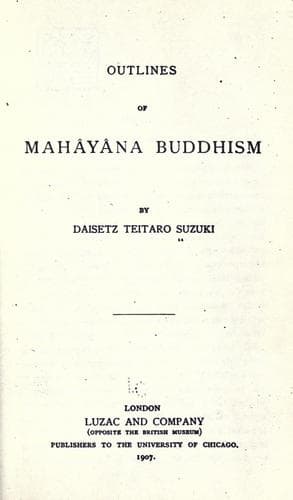
Outlines of Mahayana BuddhismSuzuki, Daisetz Teitaro
Religion
Outlines of Mahayana Buddhism
Suzuki, Daisetz Teitaro
Mahayana Buddhism -- Doctrines
In another place (_op. cit._) the idea is expressed in much plainer
terms: “The essence of all things is in truth free from attachment,
attributes, and desires; therefore, they are pure, and, as they are
pure, we know that what is the essence of birth and death that is the
essence of Nirvâna, and that what is the essence of Nirvâna that is
the essence of birth and death (_samsâra_). In other words, Nirvâna
is not to be sought outside of this world, which, though transient, is
in reality no more than Nirvâna itself. Because it is contrary to our
reason to imagine that there is Nirvâna and there is birth and death
(_samsâra_), and that the one lies outside the pale of the other,
and, therefore, that we can attain Nirvâna only after we have
annihilated or escaped the world of birth and death. If we are not
hampered by our confused subjectivity, this our worldly life is an
activity of Nirvâna itself.”
Nâgârjuna repeats the same sentiment in his _Mâdhyamika Çâstra_, when
he says:
{354}
“Samsâra is in no way to be distinguished from Nirvâna:
Nirvâna is in no way to be distinguished from Samsâra.”[150]
Or,
“The sphere of Nirvâna is the sphere of Samsâra:
Not the slightest distinction exists between them.”[151]
Asanga goes a step further and boldly declares that all the
Buddha-dharmas, of which Nirvâna or Dharmakâya forms the foundation,
are characterised with the passions, errors, and sins of vulgar minds.
He says in _Mahâyâna-Sangraha Çâstra_ (the Chinese Tripitaka, Japanese
edition of 1881, _wang_ VIII., p. 84):
“(1) All Buddha-dharmas are characterised with eternality, for the
Dharmakâya is eternal.
“(2) All Buddha-dharmas are characterised with an extinguishing power,
for they extinguish all the obstacles for final emancipation.
“(3) All Buddha-dharmas are characterised with regeneration, for the
Nirmânakâya [Body of Transformation] constantly regenerates.
“(4) All Buddha-dharmas are characterised with the power of
attainment, for by the attainment [of truth] they subjugate
innumerable evil passions as cherished by ignorant beings.
“(5) All Buddha-dharmas are characterised with the desire to gain, ill
humor, folly, and all the other {355} passions of vulgar minds, for it
is through the Buddha’s love that those depraved souls are saved.
“(6) All Buddha-dharmas are characterised with non-attachment and
non-defilement, for Suchness which is made perfect by these virtues
cannot be defiled by any evil powers.
“(7) All Buddha-dharmas are above attachment and defilement, for
though all Buddhas reveal themselves in the world, worldliness cannot
defile them.”[152]
Public-domain text, read in full here on John Shaqi.
Reviews
Reviews
No reviews yet
Be the first to share your thoughts on this work.
Elsewhere in the archive
Join the Discussion
Join the discussion
Sign in to leave a comment or review.
Sign InorCreate an account