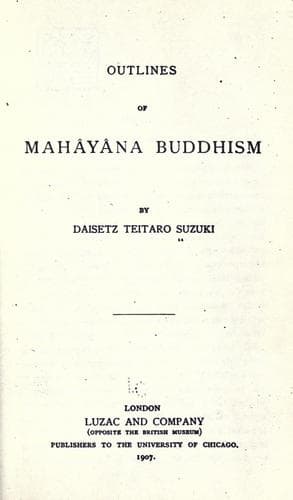
Outlines of Mahayana BuddhismSuzuki, Daisetz Teitaro
Religion
Outlines of Mahayana Buddhism
Suzuki, Daisetz Teitaro
Mahayana Buddhism -- Doctrines
When Vimalakirti was asked why he did not feel well, he made the
following reply, which is full of religious significance: “From
ignorance there arises desire and that is the cause of my illness. As
all sentient beings are ill, so am I ill. When all sentient beings are
healed of their illness, I shall be healed of my illness, too. Why?
The Bodhisattva suffers birth and death because of sentient beings. As
there is birth and death, so there is illness. When sentient beings
are delivered from illness, the Bodhisattvas will suffer no more
illness. When an only son in a good family is sick, the parents feel
sick too: when he is recovered they are well again. So it is with the
Bodhisattva. He loves all sentient beings as his own children. When
they are sick, he is sick too. When they are recovered, he is well
again. Do you wish to know whence this [sympathetic] illness is? The
illness of the Bodhisattva comes from his all-embracing love
(_mahâkarunâ_).”
This gospel of universal love is the consummation of all religious
emotions whatever their origin. Without this, there is no
religion--that is, no religion that is animated with life and spirit.
For it is in the fact {367} and nature of things that we are not moved
by mere contemplation or mere philosophising. Every religion may have
its own way of intellectually interpreting this fact, but the
practical result remains the same everywhere, viz. that it cannot
survive without the animating energy of love. Whatever sound and fine
reasoning there may be in the doctrine of the Çrâvaka and the
Pratyekabuddha, the force that is destined to conquer the world and to
deliver us from misery is not intellection, but the will, i.e. the
pûrvapranidhâna of the Dharmakâya.
_Conclusion._
We now conclude. What is most evident from what we have seen above is
that the Mahâyâna Nirvâna is not the annihilation of life but its
enlightenment, that it is not the nullification of human passions and
aspirations but their purification and ennoblement. This world of
eternal transmigration is not a place which should be shunned as the
playground of evils, but should be regarded as the place of
ever-present opportunities given to us for the purpose of unfolding
all our spiritual possibilities and powers for the sake of the
universal welfare. There is no need for us to shrink, like the snail
into his cozy shelter, before the duties and burdens of life. The
Bodhisattva, on the contrary, finds Nirvâna in a concatenation of
births and deaths and boldly faces the problem of evil and solves it
by purifying the Bodhi from subjective ignorance.
{368}
His rule of conduct is:
“Sabba pâpassa akaranam,
Kusalassa upasampada,
Sacitta pariyodapanam;
Etam buddhânu sâsanam.”[156]
His aspirations are solemnly expressed in this, which we hear daily
recited in the Mahâyâna Buddhist temples and monasteries and
seminaries:
Public-domain text, read in full here on John Shaqi.
Reviews
Reviews
No reviews yet
Be the first to share your thoughts on this work.
Elsewhere in the archive
Join the Discussion
Join the discussion
Sign in to leave a comment or review.
Sign InorCreate an account