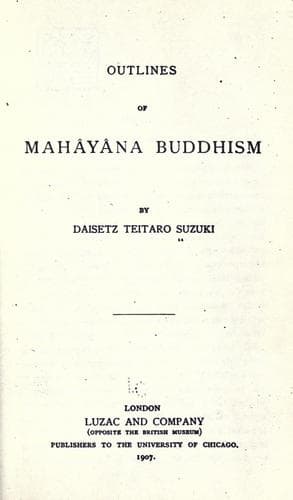
Outlines of Mahayana BuddhismSuzuki, Daisetz Teitaro
Religion
Outlines of Mahayana Buddhism
Suzuki, Daisetz Teitaro
Mahayana Buddhism -- Doctrines
Suchness, (_see also_ Bhûtatathâtâ), 3; the first principle of
Buddhism, 99 et seq.; indefinable, 101; conditioned, 109; in history,
110; in the world, 113; and the Bodhi, 114; and ignorance, 117; in its
various modes, 125; and Dharmakâya, 127; and karma, 181.
Sudurjayâ, (fifth stage of Bodhisattvahood), 318.
Sukhâvatî sect, the, 4, 240.
Sumedha, the story of, 280.
_Sûrangama Sutra_, quoted, 157.
_Suvarna Prabha Sutra_, 253 ft.
Svabhava, and non-ego, 170 et seq.; and emptiness, 175.
{419}
“Tat tvam asi,” 47, 135 ft.
Tathâgata-Garbha, 125, 145.
Teleology, 86.
Tennyson, quoted, 82.
Tîrthakas, 8.
Tolstoi, quoted, in connection with karma, 207 ft.
Trikâya, (trinity), 73, 242, 256, 275.
Truth (satya), conditional and transcendental, 95.
_Udâna_, quoted, 52, 338 ft., 341.
Universe, a mind, 122.
Upâya (expediency), 64, 260 ft.; its meaning explained, 298 ft.
Upâyajñâ, 320.
Vaiçaradyas (convictions), the four, 327 ft.
Vairocana, 219.
Vasubandhu, 87, 153; his _Abhidharmakoça_, referred to, 37; on
Mahâyâna, 66; _On the Completion of Karma_, quoted, 194; _The
Distinguishing of the Mean_, quoted, 195; on _Bodhicitta_, 303; on
Nirvana, 357, 359, 360.
Vasumitra, on _Various Schools of Buddhism_, 1 ft.
Vedanta philosophy, and the Mahâyânism, 108 ft.; on Nirvana, 340; on
Atman, 144.
_Vicesacinta-brahma-Pariprccha Sutra_, 353.
Victory, the hymn of, 336.
Vijñâna, and atman, 39.
Vijnânamâtra, (nothing but ideas), 70.
_Vijnânamâtra çâstra_, 265 ft., 343.
Vimala (second stage of Bodhisattvahood), 315.
Vimalakîrti, 106, 350, 366.
_Visuddhi Magga_, quoted, 339, 348 ft.
{420}
Waddell, refuted, 21 et seq.
Whitman, Walt, quoted, 155 ft., 197.
Wilson, Dr. G. R., quoted, 201.
Yoga philosophy, The, on Nirvana, 340.
Yogacarya school, 62, 65, 87, 92, 95.
_Yogavasistha_, a vedantic book, quoted, 167.
ENDNOTES.
INTRODUCTION NOTES.
[1] According to Vasumitra’s _Treatise on the Points of Contention
by the Different Schools of Buddhism_, of which there are three
Chinese translations, the earliest being one by Kumârajîva (who came
to China in A.D. 401), the first great schism seems to have broken out
about one hundred years after the Buddha. The leader of the dissenters
was Mahâdeva, and his school was known as the Mahâsangîka (Great
Council), while the orthodox was called the school of Sthaviras
(Elders). Since then the two schools subdivided themselves into a
number of minor sections, twenty of which are mentioned by Vasumitra.
The book is highly interesting as throwing light on the early pages of
the history of Buddhism in India.
((1))
Public-domain text, read in full here on John Shaqi.
Reviews
Reviews
No reviews yet
Be the first to share your thoughts on this work.
Elsewhere in the archive
Join the Discussion
Join the discussion
Sign in to leave a comment or review.
Sign InorCreate an account