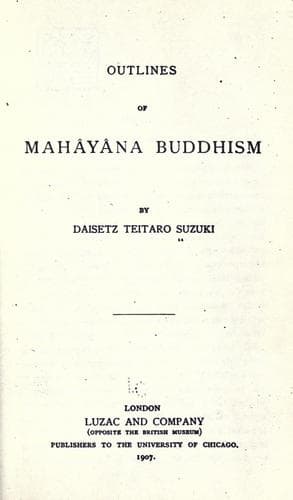
Outlines of Mahayana BuddhismSuzuki, Daisetz Teitaro
Religion
Outlines of Mahayana Buddhism
Suzuki, Daisetz Teitaro
Mahayana Buddhism -- Doctrines
“Granted the wretchedness of life, the remedy that pessimists propose
is the new religious salvation that modern Buddhists are to make
fashionable... The conception is that of Nirvâna. To sever all the
ties which attach you to the external world; to prune away all the
young offshoots of desire, and recognise that to be rid of them is a
deliverance; to practise a sort of complete psychial circumcision; to
recoil upon yourself and to believe that by so doing you enter into
the society of the great totality of things (the mystic would say, of
God); to create an inner vacuum, and to feel dizzy in the void and,
nevertheless, to believe that the void is plenitude supreme, pleroma,
these have always constituted temptations to mankind. Mankind has been
tempted to meddle with them, as it has been tempted to creep up to the
verge of dizzy precipices and look over... Nirvâna leads, in fact, to
the annihilation of the individual and of the race, and to the logical
absurdity that the vanquished are the victors over the trials and
miseries of life.”
Then, the author recites the case of one of his acquaintances, who
made a practical experiment of Nirvâna, rejecting variety in his diet,
giving up meat, wine, every kind of ragout, every form of condiment,
and reducing to its lowest possible terms the desire that is most
fundamental in every living being--the desire of food, and substituting
a certain number of cups of pure milk. “Having thus blunted his sense
of taste and the grosser of his appetites, having abandoned all
physical activity, he thought to find a recompense in the pleasure of
abstract meditation and of esthetic contemplation. He entered to a
state which was not that of dreamland, but neither was it that of real
life, with its definite details.”
[13] For detailed explanation of this term see Chapter XI.
[14] _The Udâna_, Ch. VIII, p. 118. Translation by General Strong.
[15] This is a peculiarly Indian religious practice, which consists
in counting one’s exhaling and inhaling breaths. When a man is
intensely bent on the practise, he gradually passes to a state of
trance, forgetting everything that is going on around and within
himself. The practise may have the merit of alleviating nervousness
and giving to the mind the bliss of relaxation, but it oftentimes
leads the mind to a self-hypnotic state.
[16] Here Nirvâna is evidently understood to mean self-abnegation
or world-flight or quietism, which is not in accord with the true
Buddhist interpretation of the term.
[17] The sentiment of the Golden Rule is not the monopoly of
Christianity; it has been expressed by most of the leaders of thought,
thus, for instance: “Requite hatred with virtue” (Lao-tze). “Hate is
only appeased by love” (Buddha). “Do not do to others what ye would
not have done to you by others” (Confucius). “One must neither return
evil, nor do any evil to any one among men, not even if one has to
suffer from them” (Plato, _Crito_, 49).
Public-domain text, read in full here on John Shaqi.
Reviews
Reviews
No reviews yet
Be the first to share your thoughts on this work.
Elsewhere in the archive
Join the Discussion
Join the discussion
Sign in to leave a comment or review.
Sign InorCreate an account