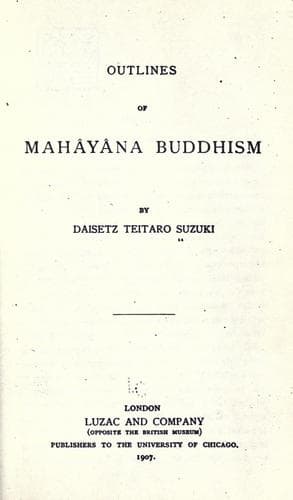
Outlines of Mahayana BuddhismSuzuki, Daisetz Teitaro
Religion
Outlines of Mahayana Buddhism
Suzuki, Daisetz Teitaro
Mahayana Buddhism -- Doctrines
In explaining these two truths, the Mâdhyamika philosophers have made
a constant use of the terms, _çûnya_ and _açûnya_, void and not-void,
which unfortunately became a cause of the misunderstanding by Christian
scholars of Nâgârjuna’s transcendental philosophy. Absolute truth is
void in its ultimate nature, for it contains nothing concrete or real
or individual that makes it an object of particularisation. But this
must not be understood, as is done by some superficial critics, in the
sense of absolute {96} nothingness. The Mâdhyamika philosophers make
the _satya_ (transcendental truth) empty when contrasted with the
realness of phenomenal existences. Because it is not real in the sense
a particular being is real; but it is empty since it transcends the
principle of individuation. When considered absolutely, it can neither
be empty nor not-empty, neither _çûnya_ nor _açûnya_, neither _asti_
nor _nâsti_, neither _abhâva_ nor _bhâva_, neither real nor unreal.
All these terms imply relation and contrast, while the _Paramârtha_
Satya is above them, or better, it unifies all contrasts and antitheses
in its absolute oneness. Therefore, even to designate it at all may
lead to the misunderstanding of the true nature of the _Satya_, for
naming is particularising. It is not, as such, an object of
intellectuation or of demonstrative knowledge. It underlies everything
conditional and phenomenal, and does not permit itself to be a
particular object of discrimination.
_Transcendental Truth and Relative
Understanding._
One may say: If transcendental truth is of such an abstract nature,
beyond the reach of the understanding, how can we ever hope to attain
it and enjoy its blessings? But Nâgârjuna says that it is not
absolutely out of the ken of the understanding; it is, on the
contrary, through the understanding that we become acquainted with the
quarter towards which our spiritual efforts should be directed, only
{97} let us not cling to the means by which we grasp the final
reality. A finger is needed to point at the moon, but when we have
recognised the moon, let us no more trouble ourselves with the finger.
The fisherman carries a basket to take the fish home, but what need
has he to worry about the basket when the contents are safely on the
table? Only so long as we are not yet aware of the way to
enlightenment, let us not ignore the value of relative knowledge or
conditional truth or _lokasamvṛttisatya_ as Nâgârjuna terms it.
“If not by worldly knowledge,
The truth is not understood;
When the truth is not approached,
Nirvâna is not attained.”[41]
Public-domain text, read in full here on John Shaqi.
Reviews
Reviews
No reviews yet
Be the first to share your thoughts on this work.
Elsewhere in the archive
Join the Discussion
Join the discussion
Sign in to leave a comment or review.
Sign InorCreate an account