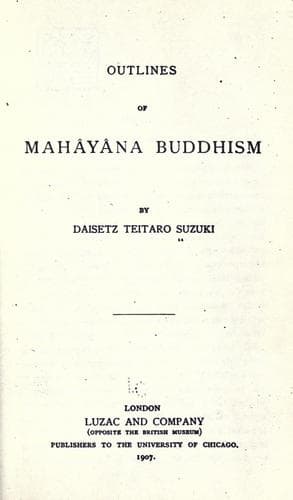
Outlines of Mahayana BuddhismSuzuki, Daisetz Teitaro
Religion
Outlines of Mahayana Buddhism
Suzuki, Daisetz Teitaro
Mahayana Buddhism -- Doctrines
From this, it is to be inferred that Buddhism never discourages the
scientific, critical investigation of religious beliefs. For it is one
of the functions of science that it should purify the contents of a
belief and that it should point out in which direction our final
spiritual truth and consolation have to be sought. Science alone which
is built on relative knowledge is not able to satisfy all our religious
cravings, but it is certainly able to direct us to the path of
enlightenment. When this path is at last revealed, we shall know how
to avail ourselves of the discovery, as then Prajñâ (or Sambodhi, or
Wisdom) becomes the {98} guide of life. Here we enter into the region
of the unknowable. The spiritual facts we experience are not
demonstrable, for they are so direct and immediate that the uninitiated
are altogether at a loss to get a glimpse of them.
CHAPTER V.
BHÛTATATHÂTÂ (SUCHNESS).
{99}
/From/ the ontological point of view, Paramârtha-satya or Pariniṣpanna
(transcendental truth) is called Bhûtatathâtâ, which literally means
“suchness of existence.” As Buddhism does not separate being from
thought nor thought from being, what is suchness in the objective
world, is transcendental truth in the subjective world, and _vice
versa_ Bhûtatathâtâ, then, is the Godhead of Buddhism, and it marks
the consummation of all our mental efforts to reach the highest
principle, which unifies all possible contradictions and spontaneously
directs the course of world-events. In short, it is the ultimate
postulate of existence. Like Paramârtha-satya, as above stated, it
does not belong to the domain of demonstrative knowledge or sensuous
experience; it is unknowable by the ordinary processes of
intellectuation, which the natural sciences use in the formulation of
general laws; and it is grasped, declare the Buddhists, only by the
minds that are capable of exercising what might be called religious
intuition.
Public-domain text, read in full here on John Shaqi.
Reviews
Reviews
No reviews yet
Be the first to share your thoughts on this work.
Elsewhere in the archive
Join the Discussion
Join the discussion
Sign in to leave a comment or review.
Sign InorCreate an account