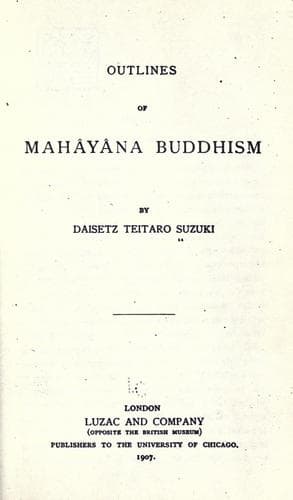
Outlines of Mahayana BuddhismSuzuki, Daisetz Teitaro
Religion
Outlines of Mahayana Buddhism
Suzuki, Daisetz Teitaro
Mahayana Buddhism -- Doctrines
When we turn to human life and history, we have the work of
conditional Suchness manifested in all forms of activity as passions,
aspirations, imaginations, intellectual efforts, etc. It makes us
desire to eat when hungry, and to drink when thirsty; it makes the man
long for the woman, and the woman for the man; it keeps children in
merriment and frolic; it braces men and women bravely to carry the
burden of life. When we are oppressed, it causes us to cry, “Let us
have liberty or die”; when we are treated with injustice, it leads us
even to murder and fire and revolution; when our noble sentiments are
aroused to the highest pitch, it makes us ready to sacrifice all that
is most dear to us. In brief, all the kaleidoscopic changes of this
phenomenal world, subjective as well as objective, come from the
playing hands of conditional Suchness It not only constitutes the
goodness and blessings of life, but the sins, crimes, and misery which
the flesh is heir to.[55]
{111}
Açvaghoṣa in his _Awakening of Faith_ speaks of the Heart (_hṛdaya_)
of Suchness and of the Heart of Birth-and-Death. By the Heart of
Suchness he means the absolute and by the Heart of Birth-and-Death a
manifestation of the absolute in this world of particulars. “They are
not separate,” however, says he, but they are one, for the Heart of
{112} Suchness is the Heart of Birth-and-Death. It is on account of
our limited senses and finite mind that we have a world of particulars,
which, as it is, is no more than a fragment of the absolute
Bhûtatathâtâ. And yet it is through this fragmentary manifestation
that we are finally enabled to reach the fundamental nature of being
in its entirety. Says Açvaghoṣa, “Depending on the Tathâgata-garbha,
there evolves the Heart of Birth-and-Death. What is immortal and what
is mortal are harmoniously blended, for they are not one, nor are they
separate..... Herein all things are organised. Hereby all things are
created.”
Public-domain text, read in full here on John Shaqi.
Reviews
Reviews
No reviews yet
Be the first to share your thoughts on this work.
Elsewhere in the archive
Join the Discussion
Join the discussion
Sign in to leave a comment or review.
Sign InorCreate an account