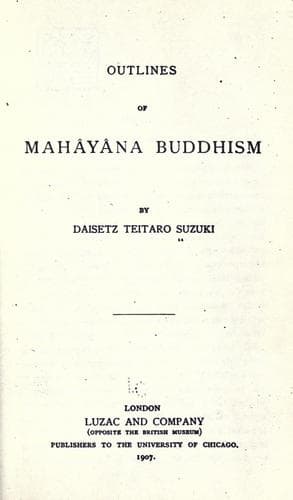
Outlines of Mahayana BuddhismSuzuki, Daisetz Teitaro
Religion
Outlines of Mahayana Buddhism
Suzuki, Daisetz Teitaro
Mahayana Buddhism -- Doctrines
The Tathâgata-Garbha, therefore, may be explained ontologically as a
state of Suchness quickened by Ignorance and ready to be realised in
the world of particulars, that is, when it is about to transform
itself to the duality of subject and object, though there is yet no
perceptible manifestation of motility in any form. Psychologically, it
is the transcendental soul of man just coming under the bondage of the
law of karmaic causation. Though pure and free in its nature as the
expression of Suchness in man, the transcendental {127} soul or pure
intelligence is now influenced by the principle of birth-and-death and
subjects itself to organic determinations. As it is, it is yet devoid
of differentiation and limitation, save that there is a bare
possibility of them. It will, however, as soon as it is actualised in
a special form, unfold all its particularities subject to their own
laws; it will hunger, desire, strive, and even be annoyed by its
material bonds, and then, beginning to long for liberation, will
struggle inwardly. Here is then no more of the absolute freedom of
Suchness, as long as its phenomenal phase alone is considered, since
the Garbha works under the constraint of particularisation. The
essence of Tathâgatahood, however, is here preserved intact, and,
whenever it is possible, our finite minds are able to feel its
presence and power. Hypothetically, therefore, the Garbha is always in
association with passions and desires that are of Ignorance.
We read in the _Çrimâlâ-Sûtra_: “With the storage of passions attached
we find the Tathâgata-Garbha,” or, “The Dharmakâya of the Tathâgata
not detached from the storage of passions is called Tathâgata-Garbha.”
In Buddhism, passion or desire or sin (_kleça_) is generally used in
contrast to intelligence or Bodhi or Nirvâna. As the latter,
religiously considered, represents a particular manifestation in the
human mind of the Dharmakâya or Bhûtatathâtâ, so the former is a
reflection of universal Ignorance in the microcosm. Therefore, the
human soul in which, according to Buddhism, intelligence and desire
are merged, should {128} be regarded as an individuation of the
Tathâgata-Garbha. And it is in this capacity that the Garbha is called
_Âlayavijñâna_.
_The Âlayavijñâna and its Evolution._
As we have seen, the Âlayavijñâna or All-Conserving Soul is a
particularised expression in the human mind of the Tathâgata-Garbha.
It is an individual, ideal reflex of the cosmic Garbha. It is this
“psychic germ,” as the Âlaya is often designated, that stores all the
mental possibilities, which are set in motion by the impetus of an
external world, which works on the Âlaya through the six senses
(_vijñâna_).
Public-domain text, read in full here on John Shaqi.
Reviews
Reviews
No reviews yet
Be the first to share your thoughts on this work.
Elsewhere in the archive
Join the Discussion
Join the discussion
Sign in to leave a comment or review.
Sign InorCreate an account