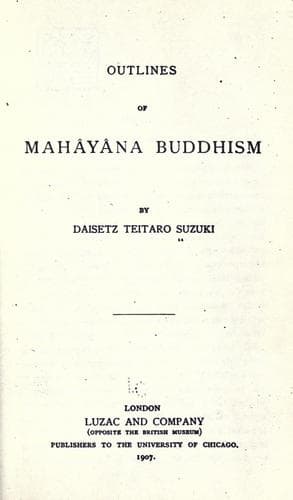
Outlines of Mahayana BuddhismSuzuki, Daisetz Teitaro
Religion
Outlines of Mahayana Buddhism
Suzuki, Daisetz Teitaro
Mahayana Buddhism -- Doctrines
Buddhism finds the source of all evils and sufferings in the vulgar
material conception of the ego-soul, and concentrates its entire
ethical force upon the destruction of the ego-centric notions and
desires. The Buddha seems, since the beginning of his wandering life,
to have conceived the idea that the way of salvation must lie somehow
in the removal of this egoistic prejudice, for so long as we are not
liberated from its curse we are liable to become the prey of the three
venomous passions: covetousness, infatuation, and anger, and to suffer
the misery of birth and death and disease and old age. Thus, when he
received his first instructions from the Sâmkhya philosopher, Arada,
he was not satisfied, because he did not teach how to abandon this
ego-soul itself. The Buddha argued: “I consider that the embodied
ego-soul, though freed from the evolvent-evolutes,[69] {147} is still
subject to the condition of birth and has the condition of a seed. The
seed may remain dormant so long as it is deprived of the opportunity
of coming into contact with the requisite conditions of quickening and
being quickened, but since its germinating power has not been
destroyed, it will surely develop all its potentialities as soon as it
is brought into that necessary contact. Even though the ego-soul free
from entanglement [i.e. from the bondage of Prakṛti] is declared to
be liberated, yet, so long as the ego-soul remains, there can be no
absolute abandonment of it, there can be no real abandonment of
egoism.”[70]
The Buddha then proceeds to indicate the path through which he reached
his final conclusion and declares: “There is no real separation of the
qualities and their subject; for fire cannot be conceived apart from
its heat and form.” When this argument is logically carried out, it
leads nowhere but to the Buddhist doctrine of non-âtman, that says:
The existence of an ego-soul cannot be conceived apart from sensation,
perception, imagination, intelligence, volition, etc., and, therefore,
it is absurd to think that there is an independent individual
soul-agent which makes our consciousness its workshop.
To imagine that an object can be abstracted from its qualities, not
only logically but in reality, that there is some unknown quantity
that is in {148} possession of such and such characteristic marks
(_lakṣana_) whereby it makes itself perceivable by our senses, says
Buddhism, is wrong and unwarranted by reason. Fire cannot be conceived
apart from its form and heat; waves cannot be conceived apart from the
water and its commotion; the wheel cannot exist outside of its rim,
spokes, axle, etc. All things, thus, are made of _hetus_ and
_pratyayas_, of causes and conditions, of qualities and attributes;
and it is impossible for our pudgala or âtman or ego or soul to be
any exception to this universal condition of things.
Public-domain text, read in full here on John Shaqi.
Reviews
Reviews
No reviews yet
Be the first to share your thoughts on this work.
Elsewhere in the archive
Join the Discussion
Join the discussion
Sign in to leave a comment or review.
Sign InorCreate an account