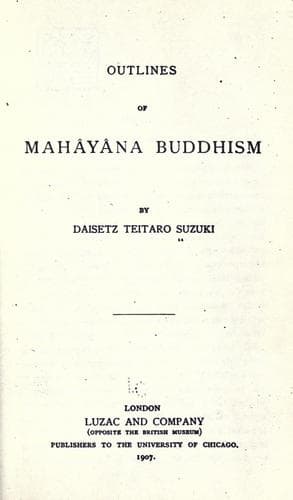
Outlines of Mahayana BuddhismSuzuki, Daisetz Teitaro
Religion
Outlines of Mahayana Buddhism
Suzuki, Daisetz Teitaro
Mahayana Buddhism -- Doctrines
Ânanda now proposes to solve the problem by locating the soul outside
the body. He says that the soul is like a candle-light placed without
this hall. Where the light shines everything is visible, but within
the room there are no candles burning, and therefore here prevails
nothing but darkness. This explains the incapacity of the soul to see
the inside of the body. But the Buddha argues that “it is impossible
for the soul to be outside. If so, what the soul feels may not be felt
by the body, and what the body feels may not be felt by the soul, as
there is no relationship between the two. The fact, however, is that
when you, Ânanda, see my hand thus stretched, you are conscious that
you have the perception of {159} it. As far as there is a
correspondence between the soul and the body, the soul cannot be said
to be residing outside the body.”
The third hypothesis assumed by Ânanda is that the soul hides itself
just behind the sense-organs. Suppose a man put a pair of lenses over
his eyes. Cannot he see the outside world through them? The reason why
it cannot see the inside is that it resides within the sense-organs.
But says the Buddha: “When we have a lens over an eye, we perceive
this lens as well as the outside world. If the soul is hidden behind
the sense-organ, why does it not see the sense-organ itself? As it
does not in fact, it cannot be residing in the place you mention.”
Ananda proposes another theory. “Within, we have the stomach, liver,
heart, etc.: without, we have so many orifices. Where the internal
organs are, there is darkness; but where we have openings, there is
light. Close the eyes and the soul sees the darkness inside. Open the
eyes and it sees the brightness outside. What do you say to this
theory?”
The Buddha says: “If you take the darkness you see when the eyes are
closed for your inside, do you consider this darkness as something
confronting your soul, or not? In the first case, wherever there
prevails a darkness, that must be thought to be your interior organs.
In the latter case, seeing is impossible, for seeing presupposes the
existence of subject and object. Besides this, there is another
difficulty. Granting {160} your supposition that the eye could turn
itself inward or outward and see the darkness of the interior or the
brightness of the external world, it could also see your own face when
the eye is opened. If it could not do so, it must be said to be
incapable of turning the sight inward.”
The fifth assumption as made by Ânanda is that the soul is the essence
of understanding or intelligence, which is not within, nor without,
nor in the middle, but which comes into actual existence as soon as it
confronts the objective world, for it is taught by the Buddha that the
world exists on account of the mind and the mind on account of the
world.
Public-domain text, read in full here on John Shaqi.
Reviews
Reviews
No reviews yet
Be the first to share your thoughts on this work.
Elsewhere in the archive
Join the Discussion
Join the discussion
Sign in to leave a comment or review.
Sign InorCreate an account