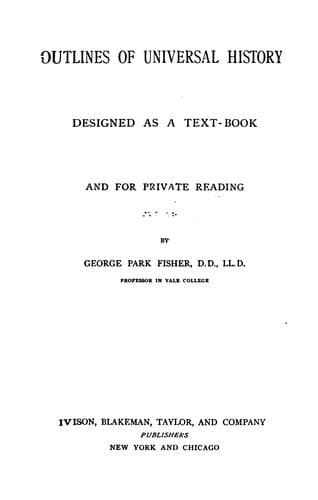
Outlines of Universal History, Designed as a Text-book and for Private ReadingFisher, George Park
History
Outlines of Universal History, Designed as a Text-book and for Private Reading
Fisher, George Park
World history
ARISTOCRATIC GOVERNMENT.--The early kings were obeyed as much for
their personal qualities, such as valor and strength of body, as for
their hereditary title. By degrees the noble families about the king
took control, and the kingship thus gave way to the rule of an
aristocracy. The priestly office, which required special knowledge,
remained in particular families, as the _Eumolpidae_e at
Athens,--families to whom was ascribed the gift of the seer, and to
whom were known the _Eleusinian mysteries_. The nobles were
landholders, with dependent farmers who paid rent. The nobles held
sway over tillers of the soil, artisans and seamen, who constituted
the people (the "demos"), and who had no share in political
power. This state of things continued until the lower class gained
more property and more knowledge; and the example of the colonial
settlements, where there was greater equality, re-acted on the parent
state. The struggle of the lower ranks for freedom was of long
continuance. In all Greek cities, there were _Metoeci_, or
resident foreigners without political rights, and also slaves from
abroad. Free-born Greeks busied themselves with occupations connected
with the fine arts, or with trade and commerce on an extended
scale. They commonly eschewed all other employments, and especially
menial labor.
THE CONSTITUTION OF THE LYCURGUS.--According to the legend, disorders
in Sparta following the Dorian conquest, and strife between the
victors and the conquered, moved _Lycurgus_, a man of regal
descent, to retire to Crete, where the old Dorian customs were still
observed. On his return he gave to the citizens a constitution, which
was held in reverence by the generations after him. To him, also, laws
and customs which were really of later date, came to be ascribed. The
Spartan population consisted (1) of the _Spartiatæ_, who had full
rights, and those of less means,--both comprising the Dorian
conquerors. They were divided into three Phylæ, or tribes, each
composed of ten divisions (Obæ); (2) the _Periæci_, Achaeans who
paid tribute on the land which they held, were bound to military
service, but had no political rights; (3) the _Helots_, serfs of
the State, who were divided among the Spartiatæ by lot, and cultivated
their lands, paying to them a certain fraction of the harvest. The
form of government established by Lycurgus was an aristocratic
republic. The Council of Elders, twenty-eight in number, chosen for
life by the Phylæ, were presided over by two hereditary kings, who had
little power in time of peace, but unlimited command of the forces in
war. The popular assembly, composed of all Spartiatæ of thirty years
of age or upwards, could only decide questions without debate. Five
_Ephors_, chosen yearly by the Phylæ, acquired more and more
authority. Lycurgus is said to have divided the land into nine
thousand equal lots for the families of the Spartiatæ, and thirty
thousand for the Periceci. To keep down the helots required constant
Public-domain text, read in full here on John Shaqi.
Reviews
Reviews
No reviews yet
Be the first to share your thoughts on this work.
Elsewhere in the archive
Join the Discussion
Join the discussion
Sign in to leave a comment or review.
Sign InorCreate an account