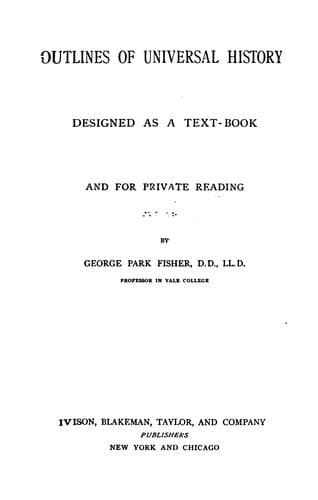
Outlines of Universal History, Designed as a Text-book and for Private ReadingFisher, George Park
History
Outlines of Universal History, Designed as a Text-book and for Private Reading
Fisher, George Park
World history
intended to make his capital, he contracted a fever, which was
aggravated by daily revels, and which terminated his life (323 B.C.),
after a reign of twelve years and eight months.
INFLUENCE OF ALEXANDER.--The Persian Empire, when it was attacked by
Alexander, was a gigantic body without much vitality. Yet to overcome
it, there was requisite not only the wonderful military talents of the
conqueror, but the vigilance and painstaking which equally
characterized him. He has been called "an adventurer." To fight and
to conquer, and to spread his dominion wherever there were countries
to subdue, seems to have been his absorbing purpose. The most
substantial result of his exploits, which read more like fable than
authentic history, was to spread _Hellenism_,--to diffuse at
least a tincture of Greek civilization, together with some
acquaintance with the Greek language, over the lands of the East. This
was a most important work in its bearing on the subsequent history of
antiquity, and more remotely on the history of all subsequent times.
CHAPTER II. THE SUCCESSORS OF ALEXANDER.
DIVISIONS OF THE EMPIRE.--Alexander left no legitimate children. The
child of Roxana, _Alexander the Younger_, was born after his
father's death. The empire naturally fell to his principal generals,
of whom _Perdiccas_, having command of the great army of Asia,
had the chief power. He was obliged to content his military
colleagues, which he did by giving to them provinces. The principal
regents, or guardians, were soon reduced to three,--_Antipater_
and _Craterus_ in Europe, and _Perdiccas_. The government
was carried on in the name of Roxana's son, and of _Arrhidaeus_,
the half-brother of Alexander. But _Perdiccas_ soon found that
each general was disposed to be in fact a king in his own dominion. He
formed the plan of seizing the empire for himself. This combined the
satraps against him. Perdiccas was supported by his friend
_Eumenes_, but had against him _Antipater_ and
_Craterus_, the other regents, and the powerful governors,
_Ptolemy Lagi_ in Egypt, and _Antigonus_ in Phrygia, Lycia,
and Pamphilia (322 B.C.). There followed a series of wars lasting for
twenty-two years, involving numerous changes of sovereignty, and fresh
partitions of territory. The rebellious satraps triumphed over the
royalists, whose aim was to keep the empire intact for the family of
Alexander. The ambition of _Antigonus_ to make himself the sole
ruler, led to a league against him (315 B.C.). In a treaty of peace,
_Cassander_, the son of Antipater, was to retain the government
of Macedonia. By him _Roxana_ and the young _Alexander_ were
put to death. In a second war against Antigonus, in which, as before,
he was supported by his son, _Demetrius Poliorcetes_, they were
completely defeated in the battle of _Ipsus_, in Phrygia (301
B.C.). Antigonus was slain: Demetrius fled to Greece. The result of
this protracted contest was, that the Macedonian empire was broken
Public-domain text, read in full here on John Shaqi.
Reviews
Reviews
No reviews yet
Be the first to share your thoughts on this work.
Elsewhere in the archive
Join the Discussion
Join the discussion
Sign in to leave a comment or review.
Sign InorCreate an account