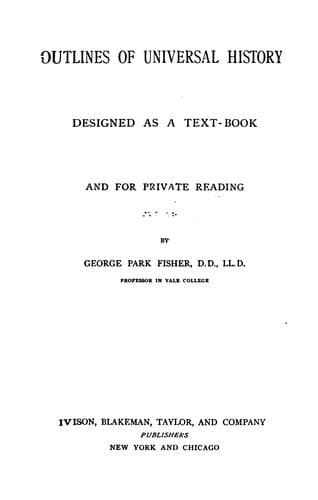
Outlines of Universal History, Designed as a Text-book and for Private ReadingFisher, George Park
History
Outlines of Universal History, Designed as a Text-book and for Private Reading
Fisher, George Park
World history
INVASION OF THE GAULS.--But the Romans joined with the Etruscans in
the attempt to drive back a dreaded enemy of both, the
_Gauls_. In the battle of the _Allia_, a brook eleven miles
north of Rome, on the 18th of July, 390 B.C., the Roman army was
routed by them, and Rome left without the means of defense. All the
people fled, except a few brave men, who shut themselves up in the
Capitol, and, according to the tradition, some aged patricians, who,
in their robes of state, waited for the enemy. The Gauls, under
_Brennus_, rushed in, and plundered and burned the city. In later
times the story was told, that, when the Gauls were climbing up to the
Capitol secretly by night, the cackling of the geese awoke _Marcus
Manlius_, and so the enemy was repulsed. There was another story,
that, when the Romans were paying the ransom required by
_Brennus_, and complained of false weight, the insolent Gaul
threw his sword into the scale, exclaiming, "Woe to the conquered!"
and that just then _Camillus_ appeared, and drove the Gauls out
of the city. This is certain, that the Gauls retired of their own free
will from their occupation of the city. The destruction of the temples
involved the loss of early chronicles, which would have given us
better information as to the times preceding. The city was rebuilt
without much delay.
THE LICINIAN LAWS.--The agitation for political reform soon commenced
again. The _Licinian Laws_, which make an epoch in the
controversy of parties, were proposed in 376, but were not passed
until 367. Besides provisions for the relief of debtors and for
limiting the number of acres of public lands to be held by an
individual, it was enacted that the military tribuneship should be
given up, and that at least one of the two consuls must be chosen from
the plebeians. A new patrician office, the _praetorship_, was
founded, the holders of which were to govern in the absence of the
consuls. The patricians did not at once cease from the effort to keep
the reins in their hands. Several times they broke the law, and put in
two patrician consuls. They yielded at last, however; and, as early as
the year 300, all Roman offices were open to all Roman citizens. The
patrician order became a social, not a legal, distinction. A new sort
of nobility, made up of both patricians and plebeians, whose families
had longest held public offices, gradually arose. These were the
_optimates_. The Senate became the principal executive body. It
was recruited by the _censors_, principally from those who had
held high stations and were upwards of thirty years old. One
_censor_ was required to be a plebeian. The condition of the
people was improved by other enactments, one of which (in 326 or 313)
secured to the debtor his personal freedom in case he should transfer
his property to the creditor. At about this time, there was a change
in the constitution of the army. The sort of arms assigned was no
longer to depend on property qualifications. There were to be three
Public-domain text, read in full here on John Shaqi.
Reviews
Reviews
No reviews yet
Be the first to share your thoughts on this work.
Elsewhere in the archive
Join the Discussion
Join the discussion
Sign in to leave a comment or review.
Sign InorCreate an account