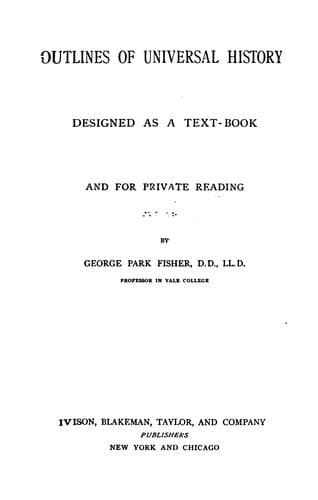
Outlines of Universal History, Designed as a Text-book and for Private ReadingFisher, George Park
History
Outlines of Universal History, Designed as a Text-book and for Private Reading
Fisher, George Park
World history
CONDITION OF ROME.--We come now to an era of internal strife. The
Romans were to turn their arms against one another: Yet it is
remarkable that the march of foreign conquest still went on. It was by
conquests abroad that the foremost leaders in the civil wars rose to
the position which enabled them to get control in the government at
home. The power of the _Senate_ had been more and more
exalted. Foreign affairs were mainly at its disposal. The increase in
the number of voters in the _comitia_, and their motley
character, made it more easy for the aristocracy to manage
them. Elections were carried by the influence of largesses and by the
exhibition of games. Practically the chief officers were limited to a
clique, composed of rich families of both patrician and plebeian
origin, which was diminishing in number, while the numbers of the
lower class were rapidly growing larger. The gulf between the poor and
the rich was constantly widening. The last Italian colony was sent out
in 177 B.C., and the lands of Italy were all taken up. Slaves
furnished labor at the cost of their bare subsistence. It was hard for
a poor man to gain a living. Had the _Licinian Laws_ (p. 137)
been carried out, the situation would have been different. The public
lands were occupied by the members of some forty or fifty aristocratic
families, and by a certain number of wealthy Italians. A great
proletariate--a needy and disaffected lower class--was growing up,
which boded no good to the state.
TIBERIUS GRACCHUS.--This condition of things moved _Tiberius
Gracchus_, the son of _Cornelia_, who was the daughter of the
great _Scipio Africanus_, to bring forward his _Agrarian
Laws_. The effect of them would have been to limit the amount of
the public domain which any one man could hold, and to divide portions
of it among poor citizens. In spite of the bitter opposition of the
nobility, these laws were passed (133). But _Gracchus_ had been
obliged to persuade the people to turn a tribune, who resisted their
passage, out of office, which was an unconstitutional act. In order to
carry out the laws, he would have to be re-elected tribune. But the
_optimates_, led by the consul _Scipio Nasica_, had been
still more infuriated by other proposals of _Gracchus_. They
raised a mob, and slew him, with three hundred of his followers. This
gave the democratic leaders a temporary advantage; but violent
measures on their own side turned the current again the other way, and
proceedings under the laws were quashed.
Public-domain text, read in full here on John Shaqi.
Reviews
Reviews
No reviews yet
Be the first to share your thoughts on this work.
Elsewhere in the archive
Join the Discussion
Join the discussion
Sign in to leave a comment or review.
Sign InorCreate an account