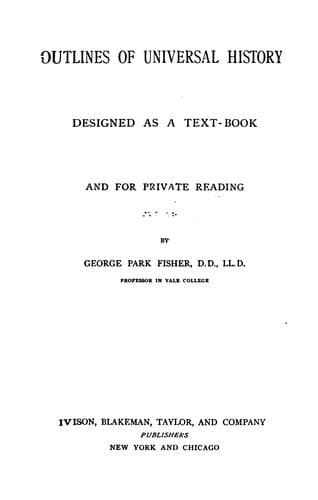
Outlines of Universal History, Designed as a Text-book and for Private ReadingFisher, George Park
History
Outlines of Universal History, Designed as a Text-book and for Private Reading
Fisher, George Park
World history
CONVERSION OF THE SAXONS--The seven kingdoms, in the ninth century
(828), were united under _Egbert_, who became king of Wessex in
802. He was called the king of England. Towards the Celtic Christians
the heathen Saxons were hostile. The conversion of the Saxons was due
to the labors of _Augustine_ and forty monks, whom _Gregory the
Great_ (Gregory I.) sent to the island as missionaries in
597. Their first conversions were in Kent, whose king,
_Ethelbert_, had married _Bertha_, the daughter of a
Frankish king. Augustine, who had great success, became the first
archbishop of _Canterbury_, and he consecrated a bishop of
London. During the seventh century the other Saxon kingdoms were
gradually converted. _York_ became a seat of a second
archbishopric. While Britain had been cut off from close relations
with the continent, the Celtic Church there had failed to keep pace
with the changes of rite and polity which had taken place among
Christians beyond the channel. The consequence was a strife on these
points between the converted Saxons, who were devoted to the holy see,
and the "Culdees" or Old British Christians.
CONVERSION OF THE IRISH.--About the middle of the fifth century the
gospel had been planted in Ireland, mainly by the labors of
_Patrick_, who had been carried to that country from Scotland by
pirates when he was a boy, and had returned to it as a missionary. The
cloisters, and the schools connected with them, which he founded,
flourished, became nurseries of study as well as of piety, and sent
out missionaries to other countries of Western Europe.
CHARACTER OF THE TEUTONIC KINGDOMS.--The Teutonic tribe was made up of
freemen and of their dependents. The rights of freemen, such as the
right to vote, continued; but these were modified as differences of
rank and wealth arose. Their leaders in peace and war were the duke
(_dux_), the count (_comes_, or _graf_), and the
_herzog_ (duke of higher grade) over larger provinces. The
companions of the king and the local chiefs grew into a nobility. Once
or twice in the year there was a gathering of the freemen in
assemblies, to decree war or to sanction laws. Land was partly held in
common, partly by individuals either as tenants of the community, or
as individual owners. The soil was shared in proportions by the
conquerors and the conquered.
Public-domain text, read in full here on John Shaqi.
Reviews
Reviews
No reviews yet
Be the first to share your thoughts on this work.
Elsewhere in the archive
Join the Discussion
Join the discussion
Sign in to leave a comment or review.
Sign InorCreate an account